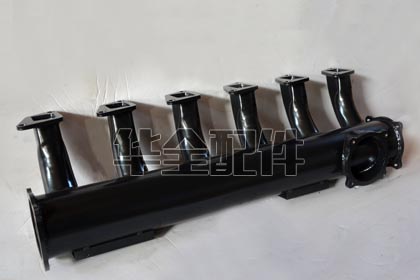
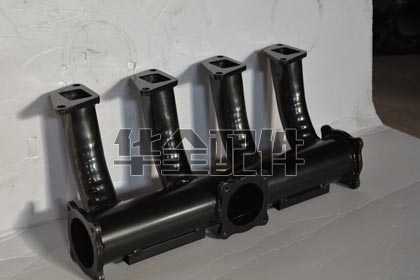
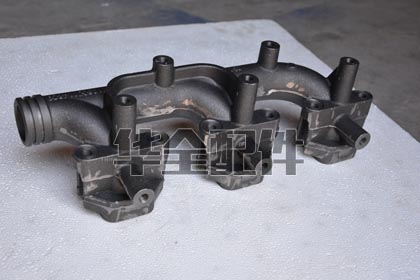
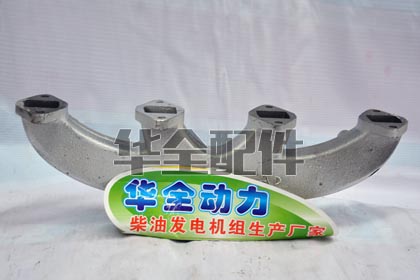
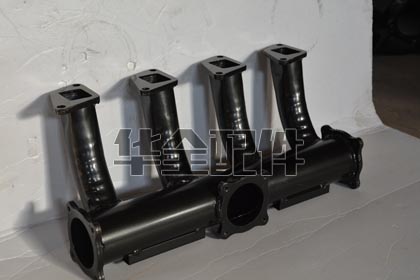
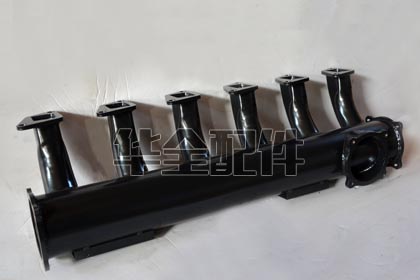
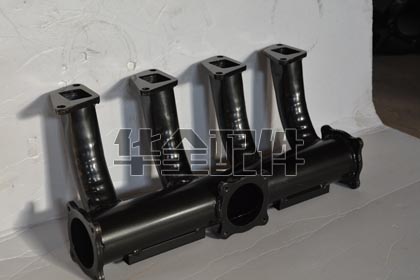
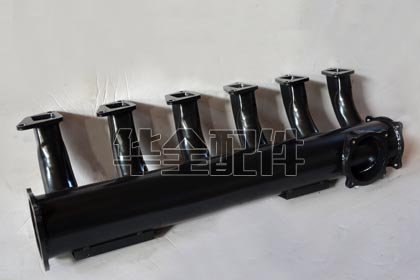
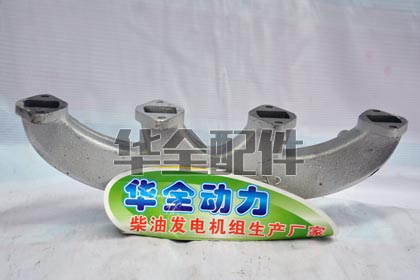
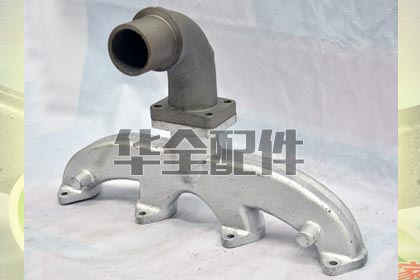
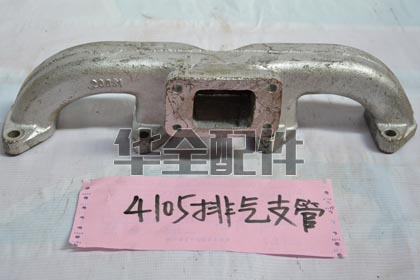
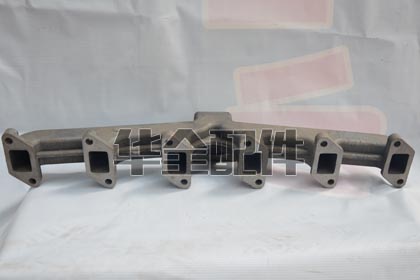
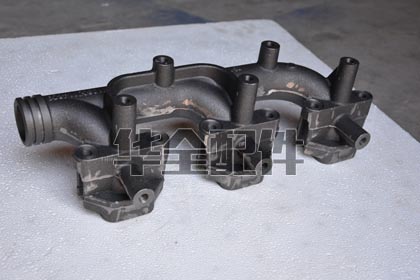
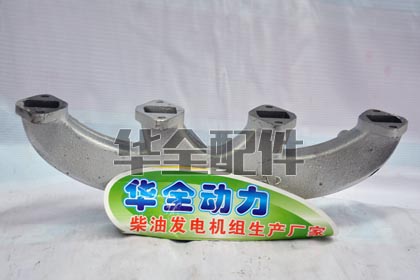
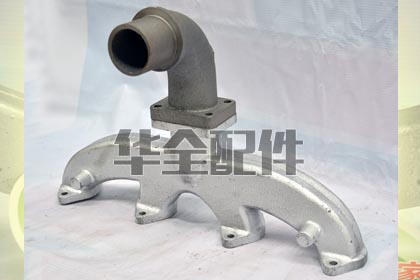
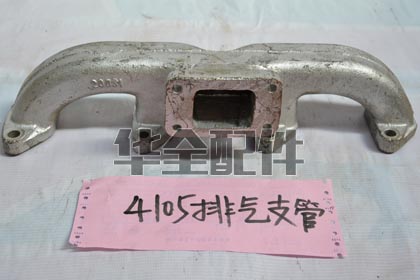
What is a generator exhaust manifold and what does it do?
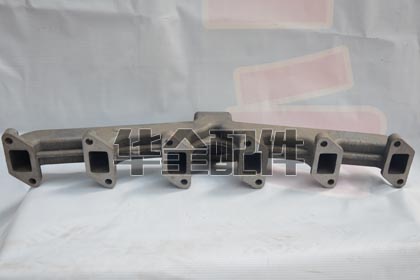
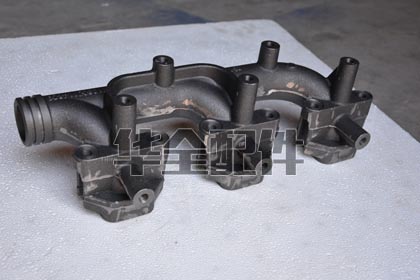
A generator exhaust manifold collects hot exhaust gases from each cylinder's exhaust port and channels them into a single outlet connected to the turbocharger or exhaust piping. It operates under extreme thermal stress: each exhaust pulse (occurring every 720/n degrees of crankshaft rotation, where n = number of cylinders) carries gas at 500-750 degrees C and velocity near the speed of sound at the valve opening. The manifold must: (1) Withstand rapid thermal cycling — from ambient to 700 degrees C in under 5 minutes during a cold start with load; (2) Resist thermal fatigue cracking from differential expansion between the hot inner surface (expanding) and cooler outer surface; (3) Maintain gas velocity for efficient turbocharger spool-up; (4) Provide mounting points for the turbocharger — supporting 20-80 kg of turbo weight plus vibration; (5) Resist external corrosion in outdoor installations. It is simultaneously a pressure containment vessel, a structural support, and a thermal management component.
What materials are generator exhaust manifolds made from?
Generator exhaust manifolds are cast from high-silicon-molybdenum (SiMo) ductile iron — typically Grade D5S (ASTM A536) with 4.0-5.5% silicon and 0.5-1.0% molybdenum. Silicon promotes formation of a stable ferritic matrix that resists growth and oxidation at high temperature. Molybdenum increases elevated-temperature strength and creep resistance. This material maintains structural integrity to 760 degrees C continuous and 820 degrees C intermittent. For high-performance or high-ambient applications, some manufacturers use high-nickel austenitic cast iron (Ni-Resist D5 with 34-38% nickel) — superior oxidation resistance to 870 degrees C but approximately 3-4x cost. Stainless steel (304/321/409) fabrications are used for some smaller engines — corrosion-resistant but more susceptible to thermal fatigue cracking than cast iron designs.
What are the signs of an exhaust manifold leak?
Manifold leak indicators: (1) Audible ticking or chuffing noise synchronized with engine RPM — each exhaust pulse creates a sharp pressure spike; (2) Black soot marks around the manifold-to-head joint or at the manifold-to-turbo joint — exhaust carbon visible as a dark trail; (3) Exhaust smell in the generator room — an occupational health hazard requiring immediate ventilation; (4) Reduced turbocharger boost pressure — exhaust energy leaking before the turbine reduces available turbine power; (5) Slower engine acceleration under load — turbo spool-up delayed; (6) Carbon monoxide detector activation in enclosed generator rooms — a life-threatening condition. A pre-turbo exhaust leak wastes 5-15% of available exhaust energy and reduces generator efficiency. Post-turbo leaks are visible as soot but have less performance impact.
Which engine brands are HUAQUAN exhaust manifolds compatible with?
HUAQUAN exhaust manifolds are cast for: Cummins (4BT, 6BT, 6CT, ISB, ISC, ISL, NT855, KTA19/38/50, QSK), Perkins (1103-4008), Deutz (912-2015), Weichai (WD615, WD618, WP10/12/13/17, 226B, 6160-6200), Yuchai (YC4, YC6, YCK), Shangchai (SC4H-SC33W), Doosan, and all Chinese diesel platforms. Cast in SiMo ductile iron to ASTM A536 D5S, each manifold is pressure-tested, faced to 0.05mm flatness on cylinder head mounting flanges, and supplied with the correct studs/nuts. Water-cooled and dry (air-cooled) versions available per the engine specification.
What causes exhaust manifold cracking?
Cracking results from: (1) Thermal fatigue — the number one cause — repeated expansion/contraction cycles create microscopic cracks at stress concentration points (sharp corners, flange-to-runner junctions) that grow with each cycle; (2) Improper mounting — missing, loose, or incorrectly torqued fasteners allow the manifold to move and vibrate; (3) Excessive turbocharger weight on the manifold without adequate support brackets — the manifold is not designed as the sole structural support; (4) Water impingement — cold water spray on a hot manifold from rain ingress or coolant leaks creates severe local thermal stress; (5) Manufacturing defects — casting porosity or inclusions in the runner walls. Cracks typically initiate at the inner surface (hottest) and propagate outward. Regular visual inspection with a borescope through the turbo opening can detect early cracking.
Can an exhaust manifold be repaired or welded?
Cast iron exhaust manifold repair is challenging but possible for non-structural cracks. Procedure: (1) Preheat the entire manifold to 500-600 degrees C in a furnace — uniform preheat is mandatory to prevent new cracking; (2) Weld using a high-nickel rod (Ni-Rod 55/99 or equivalent, 55%+ nickel content) — nickel produces a more ductile, machinable weld than iron-based filler; (3) Post-weld slow cool in the furnace or in vermiculite/insulation — rapid cooling creates brittle martensite and guaranteed re-cracking; (4) Re-face mounting flanges after welding. Success rate for properly executed repairs is 70-80% — replacement is more reliable. For critical standby generators (hospital, data center), always replace — a repaired manifold failing under emergency load is unacceptable.
What is the proper exhaust manifold installation procedure?
Correct installation: (1) Verify the cylinder head exhaust flange surface is clean, flat (within 0.05mm), and free of old gasket material; (2) Install new exhaust manifold gaskets — MLS (multi-layer steel) with graphite coating preferred for diesel applications; (3) Hand-start all manifold nuts/bolts before tightening any; (4) Follow the torque sequence — typically from the center outward in a spiral pattern; (5) Tighten in 2-3 incremental steps to the specified torque — typically 40-60 Nm for medium diesels; (6) Install the turbocharger with a new gasket, tightening to specification; (7) Re-torque manifold fasteners after the first thermal cycle (heat to operating temperature, cool overnight, re-torque cold) — this compensates for gasket compression and thermal relaxation. Many modern MLS gaskets eliminate the re-torque requirement.
What is the difference between water-cooled and dry exhaust manifolds?
Water-cooled (jacketed) manifolds have coolant circulating through internal passages around the exhaust runners, reducing skin temperature and protecting the generator room from radiated heat. Advantages: lower room temperature, safer touch temperature, and the waste heat recovered preheats engine coolant for faster warm-up. Used on marine, enclosed, and indoor generators. Dry manifolds are exposed to ambient air, simpler and lighter, with no risk of coolant-to-exhaust leakage. Used on open-frame generators. Water-cooled manifold failure (internal crack allowing coolant into the exhaust) is serious — coolant enters the turbocharger turbine housing, causing thermal shock, and may reach the engine cylinders during shutdown through open exhaust valves.
How do I inspect an exhaust manifold during engine overhaul?
Inspection procedure: (1) Clean thoroughly — media blast or chemical strip to bare metal; (2) Visual inspection under bright light — look for cracks at runner branches, flange-to-runner junctions, and turbo mounting pad; (3) Dye penetrant inspection — apply penetrant, dwell 15 minutes, developer reveals cracks visible as bright red lines; (4) Check flange flatness with a straightedge — maximum deviation 0.10mm; (5) Measure flange thickness — if eroded more than 0.5mm at any bolt location, re-facing or replacement is needed; (6) Inspect turbocharger mounting studs — replace if threads are stretched, corroded, or damaged (broken stud removal from cast iron is difficult). Pressure test if water-cooled: plug all ports, pressurize the water jacket to 2 bar, and check for leaks.
What exhaust manifold gasket material is recommended for diesel generators?
Multi-Layer Steel (MLS) with graphite coating is the premium choice: the steel layers provide structural stability for flange clamping forces (40-60 Nm), while the graphite coating fills micro-irregularities and provides a combustion-proof seal. For legacy engines, composite graphite with a steel core and expanded metal reinforcement remains common. Critical specifications: operating temperature range -40 to 800 degrees C, compressibility 15-30%, recovery above 50%, and leak rate under 0.5 ml/min at specified torque. Never use standard automotive exhaust gaskets on industrial diesel generators — the sustained high-load exhaust temperatures exceed automotive gasket ratings.
What are the consequences of an exhaust manifold restriction?
Exhaust restriction (blockage or excessive backpressure) has cascading effects: (1) Increased cylinder residual gas — each exhaust stroke cannot fully evacuate the cylinder, diluting the fresh air charge with inert exhaust gas and reducing combustion oxygen; (2) Elevated exhaust temperature — typically 50-100 degrees C above normal, stressing valves and turbocharger; (3) Increased fuel consumption — ECM compensates for reduced volumetric efficiency with more fuel; (4) Reduced power output — typically 5-15% loss; (5) Turbocharger overspeed — if the restriction is downstream of the turbine, the pressure ratio across the turbine may increase, potentially overspeeding the turbo. Maximum allowable exhaust backpressure for diesel engines is typically 3-5 kPa (12-20 inches H2O) — measure at the turbo outlet with a manometer or pressure gauge. Signs of restriction include soot buildup, collapsed internal baffles in silencers, or kinked exhaust piping.
How should exhaust manifolds be stored before installation?
Proper storage: (1) Coat all machined surfaces (flanges, turbine mounting pad) with rust-preventative oil or VCI spray; (2) Block all openings with fitted plastic plugs or tape to prevent debris and insects from entering; (3) Store in a dry, covered environment — outdoor storage causes flash rust on machined surfaces within days; (4) Keep in original packaging which includes VCI (Vapor Corrosion Inhibitor) protection; (5) Do not stack heavy objects on manifolds — cast iron is brittle under impact; (6) Store horizontally on a pallet, not on concrete. Shelf life: 10+ years when properly stored in climate-controlled conditions. Before installation, thoroughly remove all protective coatings with a suitable solvent and inspect all surfaces.
Why do exhaust manifold studs break and how to prevent it?
Exhaust manifold stud breakage is caused by: (1) Corrosion and heat cycling bonding the stud to the nut — the nut-locking torque exceeds the stud's shear strength when attempting removal; (2) Over-torquing during installation — exceeding the specification by 20% can stretch the stud beyond its elastic limit; (3) Differential thermal expansion between the steel stud (coefficient ~12x10^-6/K) and the cast iron manifold/head (~10x10^-6/K) causing cyclic stress. Prevention: (1) Always use anti-seize compound specifically rated for exhaust temperatures (nickel-based, rated to 1,300 degrees C) on stud threads during assembly; (2) Torque to specification using a calibrated torque wrench; (3) Use OEM-specification studs — generic hardware store studs lack the required high-temperature strength (Grade 8 or 10.9 minimum). For existing broken studs, use a stud extraction tool after 24-hour penetrating oil soak and local heat application around the stud boss.