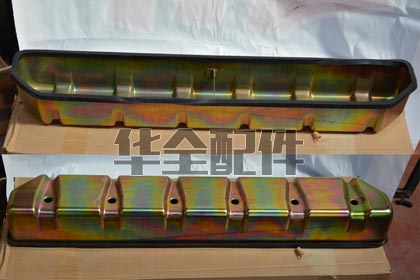
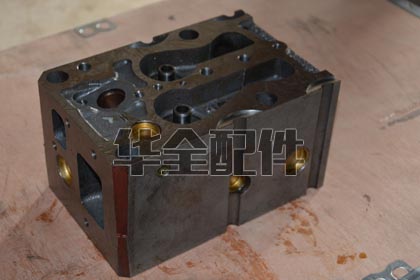
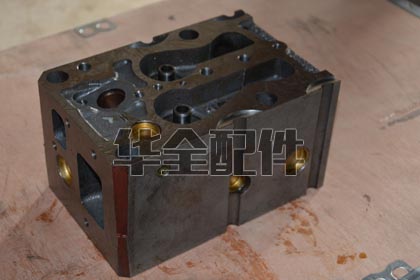
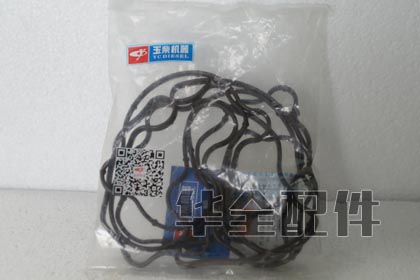
What is a generator cylinder head and what is its function?
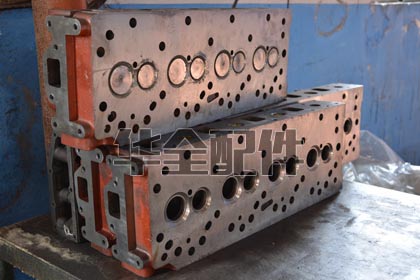
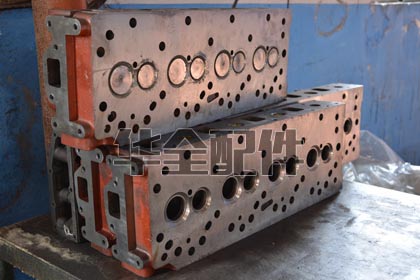
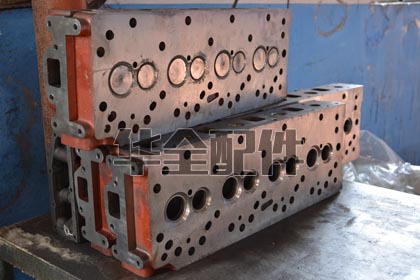
The cylinder head is the top sealing component of the engine combustion chamber, bolted to the engine block with the head gasket in between. It performs five critical functions: (1) Seals the combustion chamber top, containing peak pressures of 180-220 bar and temperatures exceeding 2,000 degrees C; (2) Houses intake and exhaust valves controlling the gas exchange process — opening 2-4 times per engine cycle at 750-900 times/minute at rated speed; (3) Contains fuel injector mounting bores with precise spray angle alignment to the piston bowl; (4) Routes coolant through internal passages around valve seats and injector sleeves — the hottest areas reaching 300-400 degrees C; (5) Provides mounting for the valve train including camshaft (OHC), rocker arms (OHV), and related components. A cylinder head typically weighs 50-200 kg and is the most geometrically complex single casting on a diesel engine.
What are generator cylinder heads made of?
Diesel generator cylinder heads are precision cast from alloyed grey cast iron (GG25-GG30 grade, equivalent to ASTM A48 Class 35-40) with alloying elements: chromium (0.25-0.45%) for thermal fatigue resistance, molybdenum (0.30-0.50%) for high-temperature strength, and copper (0.40-0.80%) for thermal conductivity. The casting process uses chemically bonded sand cores forming 20-30 internal water jacket passages. After casting, heads undergo: stress relief annealing at 550-600 degrees C, shot blasting, CNC machining of all critical surfaces to 0.02mm tolerance, and 100% pressure testing at 4-6 bar in a heated water tank. Some modern industrial engines use compacted graphite iron (CGI) for 30% higher strength at 15% lower weight.
What are the symptoms of a cracked cylinder head?
Cracked cylinder head symptoms: (1) Coolant loss without external leaks — cracks between the water jacket and combustion chamber allow coolant to be burned, producing white/grey exhaust; (2) Combustion gas in the cooling system — pressurizes the radiator, visible as continuous bubbling with the cap off (confirmed with a combustion gas test kit); (3) Oil contamination — crack between oil gallery and water jacket creates brown milky emulsion on the dipstick; (4) Compression loss on one cylinder with no apparent piston/ring/valve issue; (5) Overheating at specific loads — crack opens under thermal expansion, closing when cold (intermittent symptom); (6) Coolant in exhaust manifold — visible as rust-colored staining at the manifold-to-head joint. Cracks most commonly occur between valve seats (the thinnest bridge area) and around injector sleeves.
Which engine brands are HUAQUAN cylinder heads compatible with?
HUAQUAN supplies complete cylinder head assemblies (bare or loaded with valves, springs, guides, seats) for: Cummins (4BT, 6BT, 6CT, ISB, ISC, ISL, NT855, KTA19/38/50, QSK), Perkins (1103-4008), Deutz (912-2015), Weichai (WD615, WD618, WP10/12/13/17, 226B, 6160-6200), Yuchai (YC4, YC6, YCK), Shangchai (SC4H-SC33W), Doosan, Volvo Penta, MTU Detroit Diesel, and all Chinese diesel platforms. Each head is CNC-machined from new castings, pressure-tested, and supplied with a full inspection report including flatness, valve seat concentricity, and surface finish measurements.
Can a cracked cylinder head be repaired?
Repair feasibility depends on crack location: (1) Cracks between valve seats — repairable by professional metal stitching (cold repair using threaded pins) or furnace welding with post-weld stress relief; (2) Cracks around injector sleeves — sleeve replacement with oversized interference-fit sleeve often resolves, provided the crack does not extend into the deck surface; (3) Cracks extending to the deck surface or across the fire deck area — NOT repairable, the head has reached the end of its service life; (4) Cracks in the water jacket only — can be welded or stitched. Caveat: a repaired head will never match a new head's fatigue life due to residual stresses. For standby generators (low annual hours), repair may be economical. For prime power (continuous operation), replace with a new HUAQUAN head assembly for guaranteed reliability.
What is valve seat recession and when does it require head replacement?
Valve seat recession is the gradual sinking of the valve seat into the cylinder head casting, caused by the cumulative hammering of the valve closing millions of times. Diesel exhaust seats wear faster due to the combination of high temperature and the absence of lead (lead was a lubricant in older fuels). When recession exceeds the specification limit (typically 0.5-1.0mm total recession), several problems cascade: valve lash closes to zero, the valve cannot fully seat, compression leaks past the valve face causing localized overheating and eventual valve burning, and eventually the rocker arm or camshaft lobe experiences abnormal loading. Heads with recessed seats can be repaired by installing new hardened seat inserts and recutting the valve seat angles. If recession has cracked the seat counterbore in the casting, the head must be replaced.
How do I inspect a cylinder head during engine overhaul?
Comprehensive inspection procedure: (1) Hot tank clean to remove all carbon, oil, and scale; (2) Pressure test at 4-6 bar in heated water at 70-80 degrees C — any continuous bubble stream indicates a crack; (3) Magnetic particle inspection of deck surface and between valve seats — detects surface and near-surface cracks invisible to the naked eye; (4) Deck flatness measurement with a calibrated straightedge and feeler gauge in six directions — maximum deviation 0.05mm; (5) Valve guide ID measurement — replace if wear exceeds limit (typically 0.05-0.10mm clearance); (6) Valve seat concentricity with a dial indicator — maximum 0.03mm TIR; (7) Injector sleeve inspection with borescope for cavitation erosion or cracking; (8) All threaded holes — chase threads and inspect for cracking around bolt holes. Document all measurements for comparison against manufacturer specifications.
What is the correct valve seat angle for diesel generator cylinder heads?
Standard diesel valve seat uses a three-angle configuration: (1) 30-degree top cut — blends the seat into the combustion chamber, promoting smooth airflow during intake; (2) 45-degree sealing face — the primary sealing surface, typically 1.5-2.5mm wide for intake and 2.0-3.0mm for exhaust (wider exhaust face dissipates more heat from the valve to the cooling system); (3) 60-degree bottom cut — transitions to the port throat. The sealing face width is critical: too narrow (below 1.5mm) concentrates heat — the valve runs hotter and may burn; too wide (above 3mm) reduces seating pressure and traps carbon particles. After cutting, lap the valve with fine grinding compound to verify a continuous grey contact ring, then remove all compound residue before assembly.
What causes cylinder head warpage?
Head warpage is caused by: (1) Severe overheating — the most common cause — aluminum expands more than cast iron, but even cast iron heads warp under extreme heat when the thermal gradient between the fire deck (300+ degrees C) and the top surface (100 degrees C) exceeds the material's yield point; (2) Uneven head bolt torque — a frequently overlooked cause; (3) Coolant system failure — localized hot spots exceeding design limits; (4) Thermal shock — introducing cold coolant into a severely overheated engine can crack or warp the head. Warpage beyond 0.05-0.10mm requires re-surfacing by a qualified machine shop with the correct PCD cutter. Note: excessive material removal reduces compression ratio and affects valve train geometry.
How do I know if I need a bare or loaded (complete) cylinder head?
Choose a bare cylinder head when: the existing valves, springs, guides, and seats are in specification and you can transfer them — but factor in the labor cost of disassembly, cleaning, inspection, and reassembly (6-12 hours for a 6-cylinder head). Choose a loaded (complete) cylinder head when: multiple valves or seats need replacement, valve guides are worn, the head has high hours, you want guaranteed factory-assembled quality, or downtime is expensive. A loaded head from HUAQUAN arrives ready to install — valves lapped, lash pre-set, all components installed. For most commercial generator applications, the loaded option's higher purchase price is offset by reduced labor cost and faster return to service.
What is the role of valve guides and when should they be replaced?
Valve guides are cylindrical pressed-in bushings that provide precision alignment for the valve stem throughout its entire lift cycle. They control valve seating accuracy and transfer heat from the valve stem (operating at 400-500 degrees C for exhaust valves) to the cylinder head cooling jacket. Replace guides when: (1) Guide-to-stem clearance exceeds the service limit — typically 0.08-0.12mm for intake and 0.10-0.15mm for exhaust on medium-duty diesels; (2) Ovality exceeding 0.03mm indicating uneven wear; (3) Blue discoloration indicating overheating and loss of lubricity; (4) Any visible scoring or galling. Exhaust guides typically wear 2-3x faster than intake guides due to higher operating temperature and the exhaust valve's higher mass.
How are injector sleeves replaced in a cylinder head?
Injector sleeves are thin-walled tubes pressed into the head that isolate the fuel injector from the cooling system. Replacement procedure: (1) Remove the injector; (2) Extract the old sleeve using a specialized puller tool — never hammer out as this can crack the head; (3) Clean the bore thoroughly, removing all scale and corrosion; (4) Measure the bore — if eroded beyond the oversize limit, the head must be replaced; (5) Chill the new sleeve (freezer for 30 minutes) to slightly shrink it; (6) Apply anerobic sealant to the sleeve OD; (7) Press in with steady force using the correct driver — verify seating depth with a depth micrometer; (8) Ream or roll-burnish the sleeve ID to the specified diameter for proper injector fit and heat transfer. A leaking injector sleeve allows coolant into the combustion chamber — immediate white smoke symptom.
What is the difference between OHV and OHC cylinder heads?
OHV (Overhead Valve) heads have the camshaft in the engine block, operating valves via pushrods and rocker arms. OHC (Overhead Camshaft) heads have the camshaft directly in the head operating valves via followers or finger-type rockers. OHV is simpler and dominates medium-speed diesel generators (1,500-1,800 RPM). OHC eliminates pushrod mass, enabling higher RPM operation and is growing in modern high-speed generators due to improved breathing and reduced valvetrain inertia. Note: OHC complexity increases with 4-valve-per-cylinder heads — two camshafts (DOHC) or complex rocker systems. Most HUAQUAN generator heads are OHV configuration matching the original engine design.
How should I properly store a spare cylinder head?
Proper storage: (1) Spray all machined surfaces with rust-preventative oil or VCI coating; (2) Install protective covers over all ports and passages to prevent debris entry; (3) Store on a purpose-built stand or flat pallet — never directly on concrete (moisture migration causes rust); (4) Climate controlled: 10-30 degrees C, below 50% relative humidity to prevent flash rusting of machined surfaces; (5) Rotate the head quarterly if stored long-term — standing in one orientation may cause uneven warpage in non-climate-controlled storage; (6) Before installation, remove all protective coatings with solvent and verify flatness — a stored head can still warp. New HUAQUAN heads are shipped with full VCI packaging for safe long-term storage.