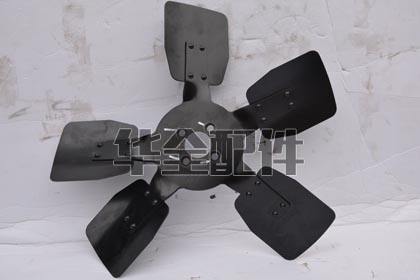
What is the function of a generator cooling fan?
The engine cooling fan provides forced airflow through the radiator core to dissipate the approximately 30% of fuel combustion energy that is rejected as heat to the cooling system. At rated power, a 500kW diesel generator rejects approximately 150kW of heat through the radiator — without forced airflow, the radiator would overheat within minutes. The fan creates a pressure differential across the radiator, with a typical pressure rise of 200-400 Pa (0.8-1.6 inches H2O) at rated speed. Fan power consumption is significant — typically 5-8% of engine output on mechanically driven fans, translating to 25-40kW parasitic loss on a 500kW generator. This energy consumption is the trade-off for adequate cooling.
What types of generator cooling fans are available?
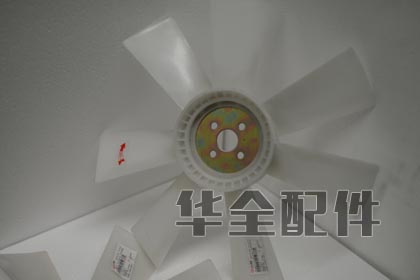
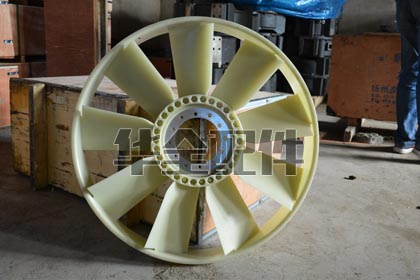
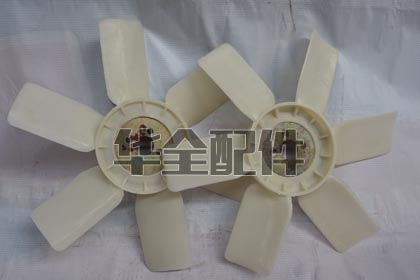
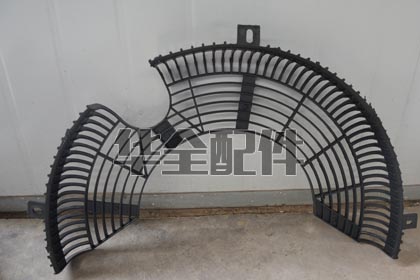
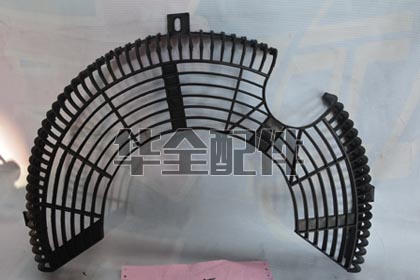
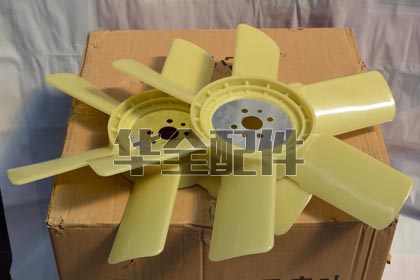
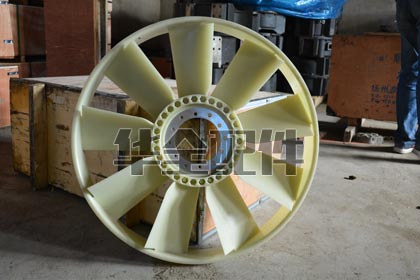
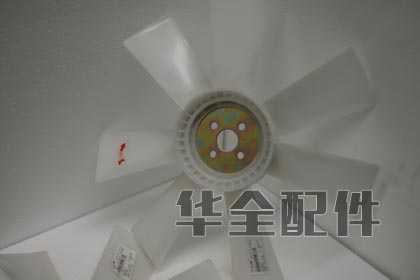
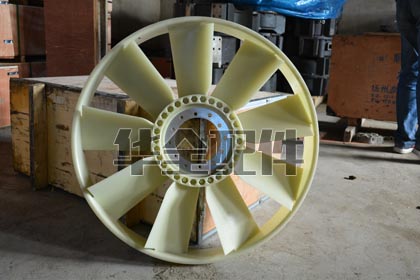
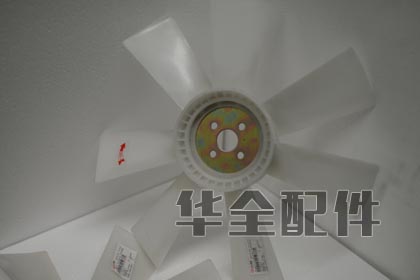
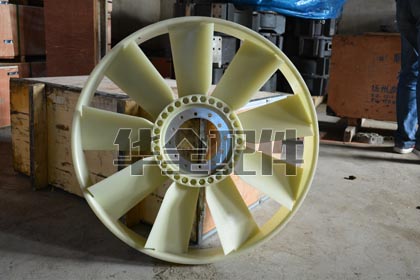
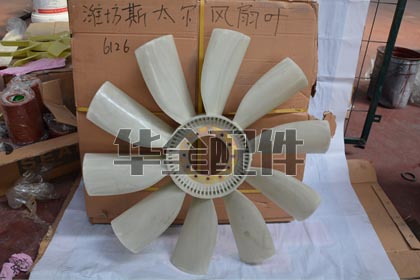
Generator cooling fans fall into four categories: (1) Fixed (direct-drive) fans — bolted directly to the water pump hub or crankshaft pulley, always running at engine speed, simplest and most reliable, but inefficient at part load (the fan runs full speed even when cooling demand is low); (2) Viscous fan clutches — temperature-activated silicone-fluid coupling that varies fan speed based on radiator outlet air temperature, reducing parasitic loss by 50-70% at part load and improving fuel efficiency; (3) Electric fans — 12V/24V DC motor-driven, independent of engine speed, fully controllable by the ECU based on actual cooling demand, common on generators below 100kW; (4) Hydraulic fans — driven by a hydraulic motor powered by the engine's hydraulic system, offering infinite speed control, used on large generators (1MW+) and specialized installations. HUAQUAN supplies replacement fan blades and complete fan assemblies for all four types.
What materials are generator fan blades made from?
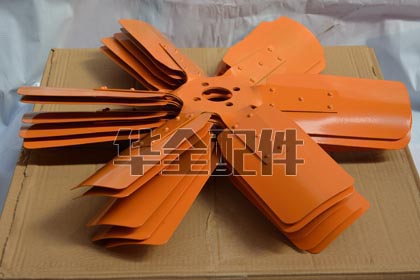
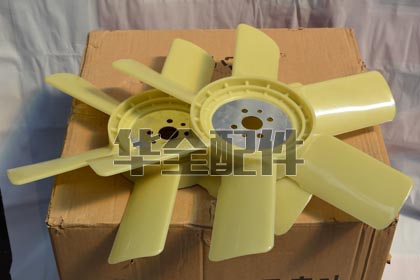
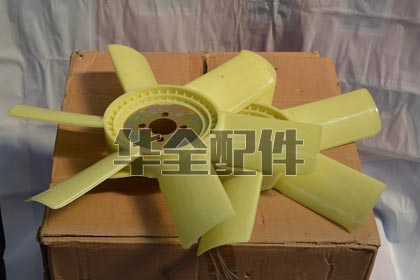
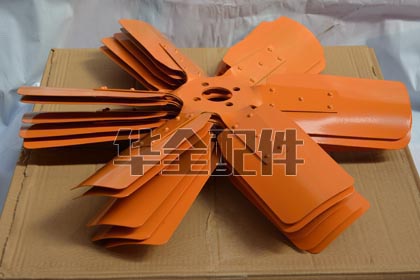
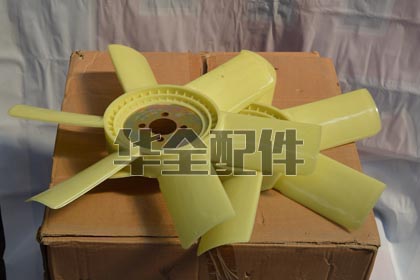
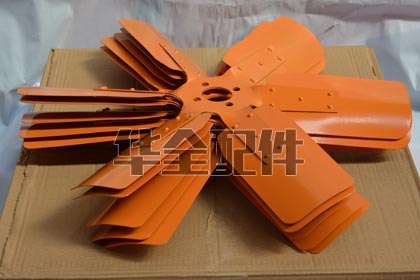
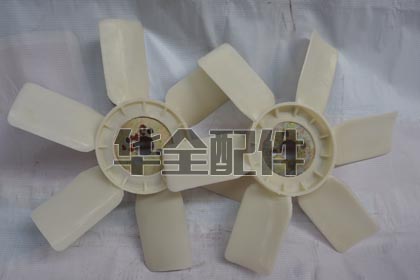
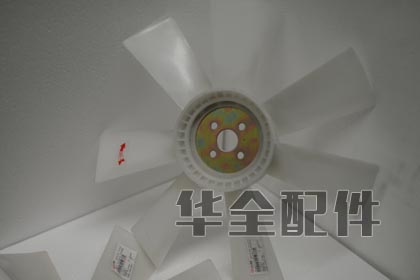
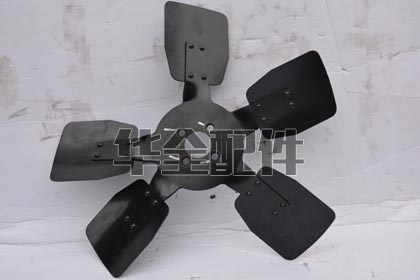
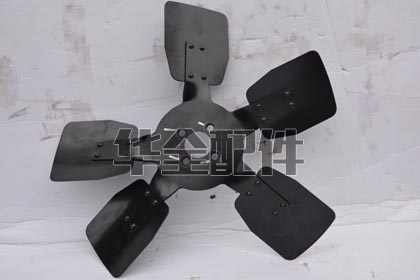
Fan blades are manufactured from: (1) Injection-molded glass-reinforced polyamide (PA6-GF30/PA66-GF30) — the modern standard for blades up to 900mm diameter. Glass fiber content at 30% provides the stiffness of aluminum at 60% of the weight. Advantages: aerodynamic optimization possible with complex 3D airfoil profiles (impossible with stamped steel), inherent vibration damping, corrosion-proof; (2) Die-cast aluminum (A380/A383) — traditional choice, higher temperature tolerance (to 180 degrees C ambient), recyclable, but heavier and limited to simpler 2D blade profiles; (3) Stamped steel — lowest cost for basic flat-blade designs, heavy, aerodynamically inefficient, mostly legacy equipment. HUAQUAN blades are injection-molded PA6-GF30 with optimized NACA-profile airfoils — providing 15-25% higher static efficiency than flat steel blades of equivalent diameter and RPM.
Which engine brands are HUAQUAN cooling fans compatible with?
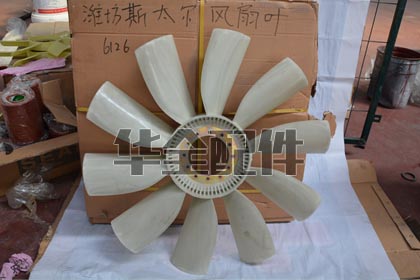
HUAQUAN cooling fans are manufactured for: Cummins (4BT-6CT, ISB-ISL, NT855, KTA19/38/50, QSK), Perkins (1103-4008), Deutz (912-2015), Weichai (WD615/618, WP10/12/13/17, 226B, 6160-6200), Yuchai (YC4-YCK), Shangchai (SC4H-SC33W), and all Chinese diesel platforms. Standard fan diameters: 450mm, 500mm, 560mm, 600mm, 630mm, 710mm, 760mm, 800mm, 900mm. Available in 4-blade, 5-blade, 6-blade, 7-blade, 8-blade, and 10-blade configurations with clockwise or counterclockwise rotation. Provide the fan diameter and number of blades — or OEM part number — for exact cross-referencing.
How do I know if my generator fan blades need replacement?
Inspection and replacement criteria: (1) Any visible crack — especially at the blade root where stress concentrates — immediate replacement mandatory. Blade cracks propagate in fatigue and a thrown blade at speed (50-70 m/s tip velocity) causes catastrophic damage; (2) Impact damage — a stone or tool strike that chips or deforms the blade edge causes imbalance. Even a 5g imbalance at the blade tip creates 50-80N centrifugal force at rated RPM; (3) Chemical attack — delamination, surface pitting, or softening of plastic blades from exposure to fuel, oil, or solvents; (4) Erosion — sand and dust gradually erode the blade leading edge, reducing aerodynamic efficiency by 10-20% and causing imbalance over time; (5) Bending — run a dial indicator on the blade trailing edge with the fan stationary — runout exceeding 2mm indicates a bent blade. Schedule replacement during every major engine overhaul.
What causes generator fan imbalance and vibration?
Fan imbalance causes: (1) Uneven blade wear or erosion — dust preferentially erodes certain blades depending on airflow patterns; (2) Dirt accumulation — mud, oil mist, and debris build-up acts as added mass on the blades; (3) Impact damage — chipped blade tip or leading edge removes mass asymmetrically; (4) Blade deformation — overheating or chemical exposure causing one blade to lose pitch angle; (5) Manufacturing tolerance — quality fans are balanced to ISO 1940 G6.3 or better at the factory; (6) Fan hub runout — a bent water pump shaft or worn bearing causes the entire fan assembly to orbit. Imbalance forces increase with the square of RPM — doubling generator speed from idle to rated quadruples the vibration amplitude. The fix: clean all blades thoroughly, inspect for damage, and if imbalance persists, perform field balancing using a vibration analyzer and clip-on balancing weights.
What is the relationship between the number of fan blades and performance?
Blade count is a design trade-off: More blades (8-10): produce higher pressure rise at a given speed — essential for densely packed radiators and charge air coolers with high airflow resistance. Disadvantage: higher power consumption and noise. Used on large industrial generators. Fewer blades (4-6): produce higher airflow at lower pressure rise with lower power consumption. Quieter operation. Used on smaller generators. Odd blade counts (5, 7, 9) are often preferred to reduce tonal noise — even-number blade counts create harmonically reinforcing sound at the blade-pass frequency (RPM x blade count / 60). Never mix blade counts between original and replacement — a 6-blade fan where a 7-blade was specified will change both cooling performance and noise characteristics.
How do I properly install a generator cooling fan?
Installation procedure: (1) Verify the correct rotation direction — fans are directional, and backward installation reduces airflow to 30-40% of rated; (2) Clean the water pump hub face and the fan hub mating surface; (3) Apply anti-seize compound to bolt threads; (4) Install extension bolts through the fan hub and into the water pump hub — start all bolts hand-tight before torquing any; (5) Tighten in a cross-star pattern in 2-3 increments to the specified torque (typically 25-35 Nm for M8 bolts, 50-70 Nm for M10); (6) Rotate the fan by hand — check for blade contact with shroud, radiator, hoses, and belts through the full 360 degrees; (7) Run the engine and observe the fan at idle speed — look for wobble indicating hub runout; (8) Re-torque bolts after the first 50 hours. A fan that separates from the hub at rated speed becomes a dangerous projectile.
What is a viscous fan clutch and when should it be replaced?
A viscous fan clutch is a thermostatic silicone-fluid coupling between the fan and the water pump shaft. A bi-metallic coil spring on the front senses radiator outlet air temperature: below 70-75 degrees C, the valve is closed and the fan freewheels at 20-30% of shaft speed; above 85-90 degrees C, the valve opens fully, coupling at 80-90% of shaft speed. Replace the clutch when: (1) It fails to engage — the generator overheats despite a clean radiator, confirmed by the fan not roaring to full speed when hot; (2) It locks permanently engaged — the fan runs at full speed continuously (fuel consumption increased 5-8% and excessive noise); (3) Silicone fluid leak — visible as a dark oily residue radiating from the clutch hub — the fluid is the working medium, and without it, the clutch cannot engage; (4) Bearing noise — grinding or rumbling from the clutch bearing. Average service life is 5-8 years or 10,000-15,000 hours.
What is the advantage of an electric cooling fan on a generator?
Electric fans offer: (1) On-demand cooling — the ECU powers the fan only when cooling is needed. A generator running at 50% load in cold weather may need zero fan operation — saving 5-8% fuel consumption compared to a mechanical fan running continuously; (2) Precise temperature control — PWM speed control maintains optimum engine temperature within +-2 degrees C, improving combustion efficiency and reducing emissions; (3) Reduced cold-start wear — the engine warms up faster without the fan running, reducing cold-operation wear; (4) Installation flexibility — electric fans can be mounted remotely for creative packaging solutions; (5) No parasitic drain at rated power — maximum engine output is available for the alternator. Limitation: high electrical demand (20-50A at 24V DC for a 50-80cm fan) requires adequate alternator capacity.
How does fan blade pitch angle affect cooling performance?
Blade pitch angle is the primary determinant of fan performance: A higher pitch angle (30-40 degrees at the tip) moves more air per revolution but requires more power — appropriate for generators operating primarily at rated load in hot climates. A lower pitch angle (20-30 degrees) moves less air at lower power consumption — appropriate for generators with variable loads or in temperate climates. The relationship is approximately cubic: a 10% increase in pitch angle increases airflow by 10-15% but power consumption by 20-30%. Fixed-pitch fans are a compromise — they must provide adequate cooling at worst-case conditions (full load, maximum ambient, radiator partially fouled) while consuming excess power at all other conditions. Variable-pitch fans (hydraulically actuated, controlled by coolant temperature) are available for generators above 1MW.
How should I store spare generator fan blades?
Storage: (1) Keep in original packaging with blade protection inserts; (2) Store flat or hanging by the hub — never on edge where weight could deform the blade profile; (3) Climate controlled: 10-35 degrees C, below 60% RH — PA6-GF30 nylon absorbs moisture (hygroscopic) which can swell the hub bore and affect balance; (4) Away from UV light — prolonged UV exposure embrittles plastic blades; (5) Away from solvents, fuels, and strong chemicals — they attack polyamide; (6) Do not stack heavy objects on blades. Shelf life: 5+ years for properly stored PA6-GF30 blades. Before installing stored blades, check for dimensional stability by verifying the hub bore diameter is within specification — a swollen hub will not seat correctly.