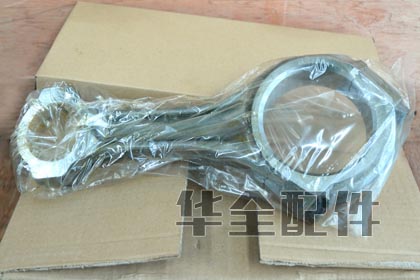
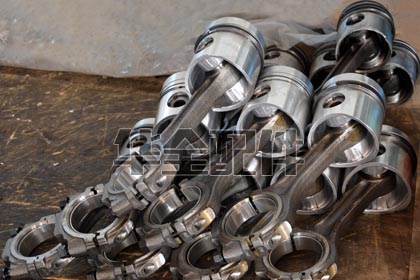
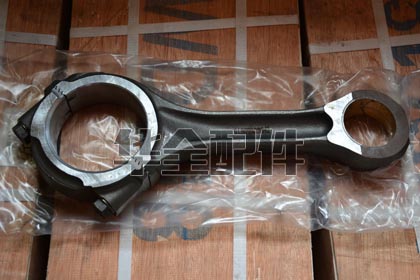
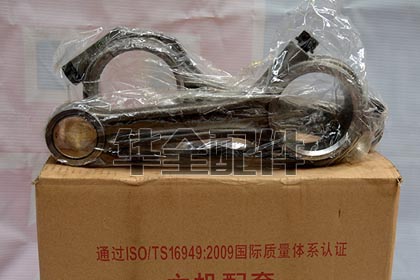
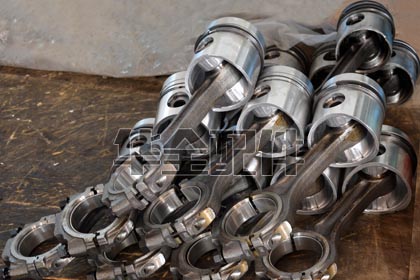
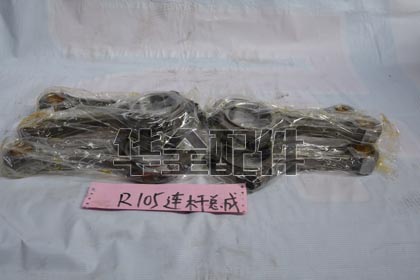
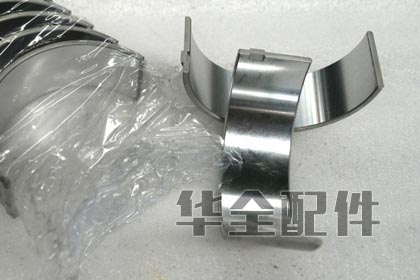
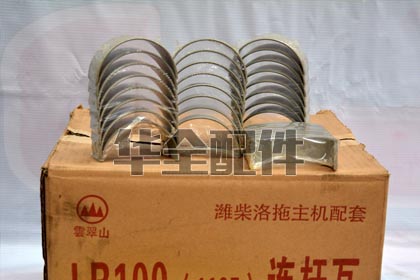
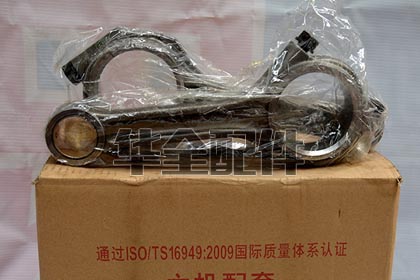
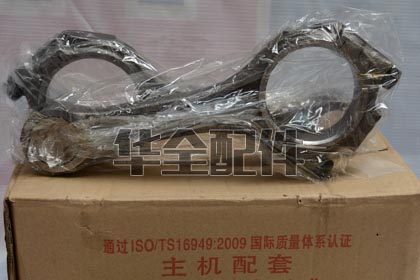
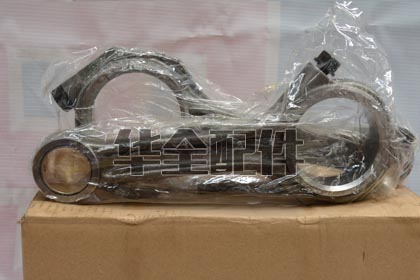
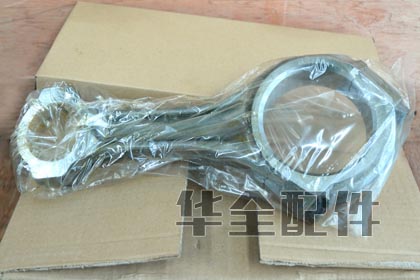
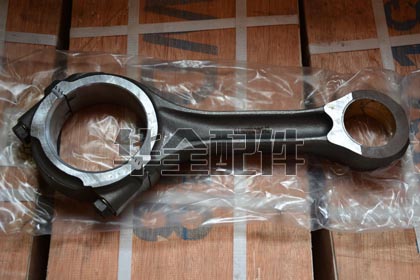
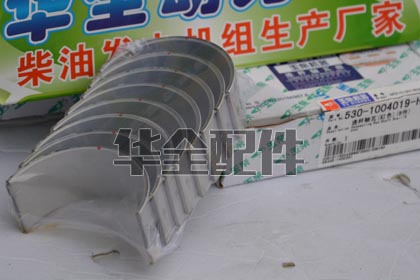
What is a generator connecting rod and what is its function?
A connecting rod is a critical engine component that converts the reciprocating motion of the piston into the rotating motion of the crankshaft. It connects the piston (via the piston pin) to the crankshaft journal. During the power stroke, combustion pressure — reaching 180-220 bar in turbocharged diesel engines — pushes down on the piston, and this force is transmitted through the connecting rod to rotate the crankshaft. The rod experiences rapidly alternating compressive loads (during combustion) and tensile loads (during exhaust/intake strokes). It is one of the three most highly stressed components in a diesel engine, alongside the crankshaft and cylinder head.
What materials are generator connecting rods made from?
Generator connecting rods are manufactured from: (1) Forged medium-carbon alloy steel (AISI 1045, 40Cr, 42CrMo) — most common for engines up to 1,000kW, offering tensile strength of 850-1,000 MPa; (2) Forged high-alloy steel (AISI 4340, 300M) — for high-output turbocharged engines above 1,200 MPa; (3) Powder metallurgy forged steel — increasingly used in modern engines for near-net-shape manufacturing; (4) Ductile cast iron — for legacy lower-speed engines. HUAQUAN connecting rods use closed-die forging with controlled grain flow for maximum fatigue resistance at the critically stressed big-end to beam transition zone.
What are the signs of a failing or bent connecting rod?
Warning signs: (1) Loud metallic knocking from deep within the engine — rod knock — increasing with RPM and not diminishing after warm-up; (2) Sudden drop in oil pressure (5-15 PSI) as increased bearing clearance allows faster oil flow; (3) Metal flakes or shiny particles in engine oil; (4) New engine vibration at a specific RPM range; (5) Visible damage through inspection ports — discoloration, cracks, or deformation. A bent rod typically results from hydrolock, severe over-speeding, or foreign object ingestion. Any suspected rod failure requires immediate shutdown to prevent the rod from punching through the crankcase — a total engine loss.
Which engine brands are HUAQUAN connecting rods compatible with?
HUAQUAN connecting rods are manufactured for diesel engines from: Cummins (4BT, 6BT, 6CT, ISB, ISC, ISL, NT855, KTA19/38/50, QSK series), Perkins (1103, 1104, 1106, 1306-4008 series), Deutz (912, 913, 1013, 2012, 2013, 1015 series), Weichai (WD615, WD618, WP10, WP12, WP13, 226B, 6160, 6170 series), Yuchai (YC4, YC6, YCK series), Shangchai (SC4H, SC7H, SC8DK, SC9DF, SC12E, SC25/27 series), MTU Detroit Diesel, Volvo Penta, and all Chinese diesel platforms. Each rod is individually magnetic particle inspected and dimensionally verified before shipment.
How do I identify the correct connecting rod for my generator engine?
To identify the correct connecting rod: (1) Record the complete engine model, specification number, and serial number from the data plate; (2) Find the OEM connecting rod part number from the parts catalog (examples: Cummins 3904166/3904167, Perkins 3112C041/3112C031, Weichai 61500010045); (3) If the part number is unavailable, measure key dimensions: center-to-center length, big-end bore diameter, small-end bushing diameter, big-end width, and bolt specifications; (4) Note whether the engine is turbocharged — turbocharged rods are typically stronger. Provide any three data points for guaranteed accurate cross-referencing.
Should connecting rod bolts be reused or replaced during overhaul?
Connecting rod bolts must ALWAYS be replaced during any engine overhaul — never reuse them. Rod bolts are typically torque-to-yield (TTY) fasteners, designed to be tightened into their plastic deformation zone for controlled clamping force. Reusing TTY bolts risks: insufficient clamping force, fatigue fracture (a broken bolt causes instantaneous catastrophic engine destruction), and uneven bolt stretch causing bearing bore distortion. For non-TTY bolts, measure bolt free length against the service limit — replace if stretched beyond 0.025mm. New rod bolts cost $20-80 per set — trivial compared to a destroyed engine ($5,000-$50,000+).
What is the proper connecting rod bolt torque procedure?
Torque procedure: (1) Clean threads and cap mating surfaces with solvent; (2) Lubricate bolt threads and under-head surfaces with clean engine oil; (3) Hand-tighten both bolts evenly; (4) Tighten in 2-3 incremental steps (e.g., 30 Nm, then 60 Nm, then 90 Nm final); (5) For TTY bolts: tighten to initial torque, then add specified angle rotation (e.g., 90 degrees + 90 degrees) using an angle gauge; (6) For stretch bolts: measure bolt elongation until specification is reached (typically 0.10-0.15mm); (7) Verify — the rod must rotate freely on the crank journal with no binding. Any resistance indicates a problem requiring immediate resolution.
What causes connecting rod bearing failure?
Bearing failures result from: (1) Oil starvation — the number one cause — from clogged galleries, failed pump, low oil level, or aerated oil; (2) Dirt/debris contamination — particles larger than oil film thickness embed in the bearing overlay and score the journal; (3) Overloading from excessive cylinder pressure; (4) Fuel dilution thinning the oil; (5) Coolant contamination destroying the bearing overlay; (6) Assembly errors — incorrect bearing crush, mixed-up bearing caps, or wrong torque causing bore distortion.
How do I inspect a connecting rod for reuse during overhaul?
Inspection procedure: (1) Magnetic particle inspection (Magnaflux) — the definitive test for surface and near-surface cracks, mandatory at the bolt boss-to-beam transition; (2) Measure big-end bore diameter — out-of-round exceeding 0.025mm requires re-boring or replacement; (3) Check center-to-center length against specification — bent rods measure shorter; (4) Measure small-end bushing ID — replace if clearance exceeds wear limit; (5) Inspect for heat damage — any discoloration means the rod's heat treatment is compromised; (6) Inspect bolt threads and seating surfaces. When in doubt, replace — the cost of a failure justifies conservative inspection.
What is the difference between fractured-split and machined connecting rods?
Fractured-split rods are forged as one piece, then the cap is separated by fracturing along a laser-etched notch, creating a unique interlocking surface. Advantages: superior alignment, lighter weight, 30-40% lower cost. Critical limitation: they CANNOT be resized during overhaul and CANNOT be mixed between engines. Machined rods have flat, ground mating surfaces and can be resized during overhaul. Most engines designed after 2005 use fractured-split rods.
When should connecting rods be replaced vs. reconditioned?
Replace rods when: any crack is found on MPI, big-end bore is out-of-round beyond resizing limits, center-to-center length is outside specification, heat discoloration is present, bolt hole threads are damaged, small-end has spun a bushing, or the rod is fractured-split type with any damage. Reconditioning is only feasible for machined rods with no cracks and dimensions within resizable limits. HUAQUAN supplies complete replacement connecting rods for most diesel engine models.
What is the weight matching requirement for connecting rods?
All connecting rods in a generator engine must be weight-matched within tight tolerance: +-2-3 grams for high-speed engines (1,500-1,800 RPM) and +-5 grams for medium-speed engines (1,000-1,500 RPM). Unmatched weights cause increased vibration, uneven main bearing loading, and crankshaft bending stress. All HUAQUAN connecting rods are supplied as weight-matched sets. When replacing a single rod, it must be matched to within +-2 grams of the remaining rods. Modern balancing targets both big-end and small-end weight independently for precise dynamic balance.
How does turbocharging affect connecting rod design requirements?
Turbocharging dramatically increases rod requirements: peak cylinder pressure can reach 180-220 bar compared to 120-140 bar in naturally aspirated engines — rods must withstand approximately 60% higher forces. The rod beam cross-section is typically 15-25% thicker with a more robust profile. Material upgrades from medium-carbon to alloy steel with higher strength are standard. Critical warning: never install naturally aspirated rods into a turbocharged engine — the reduced-strength rod will fail catastrophically under boost pressure, usually within the first 100 hours.
What is the small-end bushing and when should it be replaced?
The small-end bushing is a thin-walled bronze or bi-metal bearing pressed into the top of the connecting rod, providing the bearing surface for the piston pin. Replace when: clearance exceeds wear limit (typically 0.05-0.08mm), the bushing shows scoring or embedded debris, it has rotated in the rod bore, or during any major overhaul as preventative maintenance. Replacement requires pressing out the old bushing, pressing in a new one with oil hole alignment, and precision-honing the ID to specification — a machine shop operation.
Can a damaged connecting rod cause damage to other engine components?
Absolutely — a damaged connecting rod triggers cascade failure: a bent rod causes scored cylinder bores, galled pistons, and unseated rings leading to blow-by and oil consumption. A failed rod bearing sends metal debris through the entire oil system, damaging main bearings, turbocharger bearings, and oil pump. A broken rod bolt at speed causes the loose rod to punch through the crankcase (ventilated block), destroying adjacent cylinders and totaling the engine. What starts as a $200 rod replacement can cascade into a $30,000+ complete engine replacement — this is why bearing inspection and connecting rod maintenance at recommended intervals is not optional.