What is a generator fan housing/shroud and what is its function?
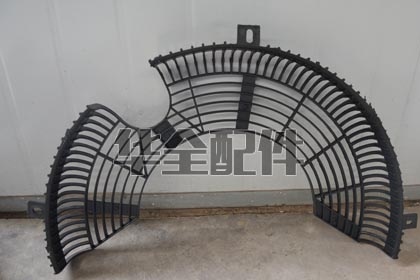
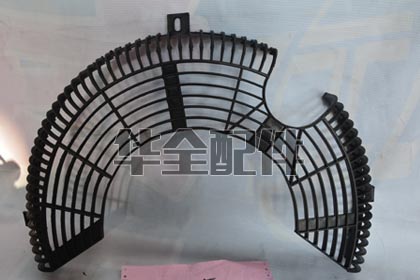
A fan housing (also called a fan shroud) is a precisely shaped enclosure that surrounds the engine cooling fan, directing airflow from the fan blades through the radiator core. Without a shroud, the fan pulls air from all directions — including hot recirculated air from the engine compartment. The shroud confines the airflow into a cylindrical duct, creating a pressure differential that forces air through the radiator core at high velocity. This dramatically increases cooling efficiency: a properly fitted shroud can improve airflow by 30-50% compared to an unshrouded fan at the same RPM. Functions include: (1) Airflow management — prevents recirculation and tip losses; (2) Safety guard — prevents personnel contact with rotating fan blades — an OSHA requirement in many jurisdictions; (3) Structural support — provides mounting for the fan ring and, on some designs, auxiliary components; (4) Noise reduction — ducted airflow is quieter than open blower airflow.
What materials are generator fan shrouds made from?
Fan shrouds are manufactured from three primary materials: (1) Sheet steel (1.2-2.0mm) — stamped and welded construction, high durability, excellent structural rigidity, standard for industrial generators above 100kW. The steel is typically powder-coated or painted for corrosion resistance; (2) Fiberglass-reinforced plastic (FRP) — lightweight, corrosion-proof (essential for marine and coastal installations), noise-dampening, but lower impact resistance and higher cost; (3) Injection-molded polypropylene/PE — used on small generators below 50kW, low cost, adequate durability for light-duty applications. HUAQUAN shrouds are laser-cut from galvanealed steel sheet, precision-formed on CNC press brakes, and powder-coated for 500-hour salt spray resistance.
What is the correct clearance between the fan blade tip and the shroud?
Optimal tip clearance is 10-15mm (0.4-0.6 inches) for industrial generator fans (600-900mm diameter). This is a critical dimension: too tight (below 5mm) risks blade contact during engine vibration, engine mount flex, or thermal expansion — catastrophic shroud destruction and potential radiator core damage. Too loose (above 25mm) allows significant air recirculation around the blade tips — up to 25% airflow loss at 25mm clearance. The clearance should be measured at the tightest point in the full 360-degree rotation. For offset fan installations (common on engines without a viscous fan clutch), the clearance varies around the circumference — ensure the minimum exceeds 8mm at any point. Check clearance both cold and after the engine reaches operating temperature to account for thermal expansion.
Which engine brands are HUAQUAN fan shrouds compatible with?
HUAQUAN fan shrouds are manufactured for radiator packages on: Cummins (4BT-6CT through QSK series), Perkins (1103-4008), Deutz (912-2015), Weichai (WD615/618, WP10/12/13/17, 226B, 6160-6200), Yuchai (YC4-YCK), Shangchai (SC4H-SC33W), and all Chinese diesel generator platforms. Shrouds are engineered for specific radiator core dimensions and fan diameters — typical diameter range 500-1,200mm (20-47 inches). Each shroud is supplied as a complete assembly: shroud body, fan ring, mounting brackets, and bolt kit. For custom radiator configurations, provide core dimensions and fan diameter for fabrication.
Why is my generator overheating despite a working fan and radiator?
If the fan spins and the radiator appears clean but the generator still overheats, the fan shroud may be the culprit: (1) Missing shroud — the most common cause. Without a shroud, the fan recirculates hot engine compartment air rather than pulling fresh air through the radiator; (2) Damaged or severely dented shroud disrupting airflow pattern; (3) Shroud not sealed against the radiator — air leaks around the edges, bypassing the radiator core entirely; (4) Incorrect tip clearance — too large gaps allow airflow recirculation; (5) Reversed fan installation — the fan is oriented backward, pushing air forward instead of pulling it through the radiator; (6) Shroud inlet design restricting airflow at high RPM — the inlet area should be at least 1.2x the fan swept area. Fixing shroud issues often resolves chronic overheating when all other cooling system components test normal.
Can I run a generator without a fan shroud?
Running without a shroud is strongly discouraged. Without a shroud, cooling efficiency drops 30-50% — the fan acts as a simple mixer, circulating hot engine compartment air rather than creating a directed airstream through the radiator. At full load in ambient temperatures above 30 degrees C, the coolant temperature will likely climb into the warning zone. Furthermore, an unshrouded fan is a serious safety hazard — rotating at 1,500-1,800 RPM, the blade tips have a peripheral speed of 50-70 m/s and can cause severe injury. Many safety codes (OSHA 1910.212, ISO 13857) mandate fan guarding. The only exception: temporary emergency operation at reduced load to move the generator or complete a critical process before proper repair.
How do I measure for a replacement fan shroud?
Measure: (1) Radiator core dimensions — height, width, and bolt-hole pattern spacing; (2) Fan diameter — tip-to-tip measurement with the engine off (safety critical); (3) Fan-to-radiator distance — from the fan blade plane to the radiator core face; (4) Shroud depth — the overall depth from the radiator mounting surface to the shroud inlet ring; (5) Inlet ring inner diameter — this should be the fan diameter + 20-30mm (for 10-15mm tip clearance); (6) Mounting hole diameter and spacing — typically 6-8 bolts on the radiator frame. If the original shroud is available, photograph it with a tape measure in frame from multiple angles — this is often sufficient for HUAQUAN to identify or fabricate the correct replacement.
What is the difference between a pusher and puller fan shroud configuration?
Puller configuration (fan behind the radiator, pulling air through): standard for 90% of industrial generators. The fan creates negative pressure behind the radiator, drawing ambient air through the core. The engine is on the cold-air side — benefit for component longevity. Shroud is a converging duct. Enhances natural ram air effect when wind blows toward the radiator. Pusher configuration (fan in front of the radiator, pushing air through): used when space behind the radiator is limited, or for remote radiator installations. The fan pushes air through the core. Less efficient because the fan's turbulent wake hits the radiator at uneven velocity. Requires the shroud to seal to the radiator core perimeter. For correct replacement, confirm whether your generator uses a pusher or puller configuration — the shroud design differs fundamentally.
How should a fan shroud be mounted and sealed?
Proper mounting: (1) The shroud must be rigidly bolted to the radiator frame, not the engine — engine vibration will fatigue the shroud and potentially crack it; (2) Install a flexible rubber or foam sealing strip (EPDM or silicone, rated to 120 degrees C) around the shroud-to-radiator mating surface — even a 5mm gap can leak 15-20% of airflow; (3) Use all mounting points — do not skip bolts, as the shroud experiences aerodynamic buffeting forces at rated RPM; (4) Apply thread-locking compound on all fasteners — vibration is constant and can loosen bolts within hours; (5) For two-piece shrouds, ensure the seam is tightly aligned with no gap. After installation: start the engine, run to operating temperature, and use a smoke stick or piece of tissue paper around the seal perimeter to check for air leaks — reseal any leaks found.
What causes fan shroud cracking or fatigue failure?
Causes: (1) Vibration — the number one killer. If the shroud is rigidly mounted and the radiator flexes on its mounts, the shroud cracks at mounting points. The fix is vibration-isolated mounts or mounting the shroud directly to the radiator frame; (2) Thermal cycling — sheet metal expands and contracts, and over thousands of cycles, fatigue cracks initiate at sharp corners and weld joints; (3) Fan blade strike — from excessive tip clearance or a failed fan bearing allowing the fan to walk into the shroud; (4) Road shock — for mobile generators, the constant vibration and shock of transport; (5) Corrosion thinning — steel shrouds exposed to the elements, especially in coastal or chemical environments; (6) Resonant vibration — when the shroud's natural frequency matches the engine firing frequency, amplifying vibration amplitudes. A crack-stop hole drilled at the crack tip (3-5mm diameter) can temporarily arrest crack growth until the next service window for replacement.
How does fan shroud design affect generator noise levels?
Shroud design significantly impacts noise. Fan noise is the dominant noise source on air-cooled generators above 50kW, and the shroud functions as both an acoustic reflector and a noise-directing structure. Design factors: (1) Bellmouth inlet — a smooth radiused inlet ring reduces turbulence and broadband noise by 3-5 dBA compared to a sharp-edged inlet; (2) Stator vanes — guide vanes in the shroud straighten the swirling airflow downstream of the fan, recovering dynamic pressure and reducing roar — a 2-4 dBA reduction; (3) Shroud material — fiberglass shrouds have inherently better vibration damping than steel, reducing radiated noise; (4) Clearance — tight tip clearance reduces tip vortex noise. For noise-sensitive installations (hospitals, residential areas), specify an acoustic shroud package with a bellmouth inlet and sound-absorbing lining on the shroud interior.
What should I consider when upgrading to a larger fan and shroud?
Upgrading to a larger fan for improved cooling requires: (1) Verify the radiator frame can physically accommodate the larger shroud — the shroud mounting bolt pattern must fit; (2) Ensure the larger fan's power consumption does not overload the fan drive (belt or direct-drive) — a 10% larger fan diameter increases power consumption by approximately 33% (cubic relationship); (3) Check fan-to-engine clearance — the larger fan must not contact hoses, belts, alternator, or other accessories; (4) Verify the water pump and thermostat flow capacity — more airflow through the radiator is wasted if the coolant cannot circulate fast enough; (5) Consider the alternator and belt load — a larger fan consumes more crankshaft horsepower; (6) Check hood/enclosure clearance for the larger shroud. HUAQUAN provides engineering guidance for cooling system upgrades — contact us with your current configuration and cooling goals.