What is a generator oil pump and how does it work?
The engine oil pump is the heart of the lubrication system — a positive-displacement pump (typically a gear-type or gerotor design) that pressurizes and circulates engine oil through every bearing, bushing, piston cooling nozzle, and turbocharger bearing in the engine. It is driven by the engine crankshaft through the geartrain at a fixed ratio, typically 0.5-0.8x crankshaft speed. A 500kW diesel generator's oil pump circulates approximately 60-100 liters of oil per minute at operating pressure — moving the engine's entire oil volume (typically 30-60 liters) through the system every 20-30 seconds. The pump is designed as positive displacement: oil flow is directly proportional to engine speed (higher RPM = higher flow), and a pressure relief valve limits maximum pressure to protect the filter and gaskets (typically 4-6 bar at operating speed). This is a life-critical component — pump failure destroys the engine within 30-60 seconds.
What are the symptoms of a failing oil pump?
Warning signs: (1) Low oil pressure warning light or gauge — the most direct indicator. Pressure below 1 bar at idle or 2-3 bar at rated speed demands immediate investigation. However, low pressure can also be caused by worn bearings (increased clearance = increased flow = pressure drop), not necessarily a bad pump; (2) Fluctuating oil pressure — the gauge needle oscillates or drops momentarily, indicating pump gear wear causing erratic flow; (3) Metallic noise from the front of the engine — worn pump gears create a distinct whining or rattling sound that increases with engine speed; (4) Metal particles in the oil filter during inspection — pump gear or housing material (steel or aluminum) in the filter media; (5) Oil analysis showing rapidly increasing wear metals — bearings that are wearing faster due to reduced oil flow. Confirmation: measure oil pressure at the main oil gallery with a calibrated test gauge — never trust a faulty gauge or sensor.
What types of oil pumps are used on diesel generator engines?
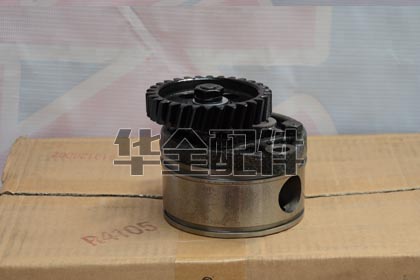
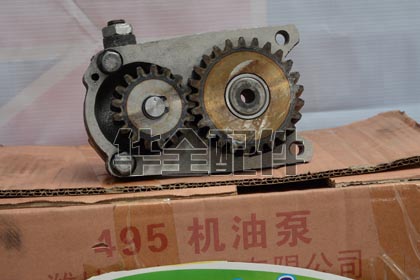
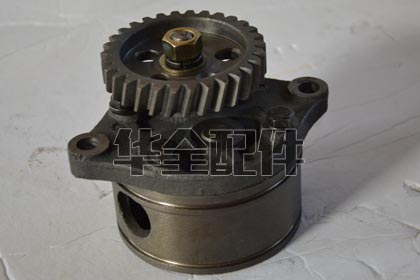
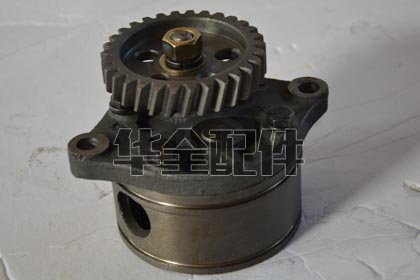
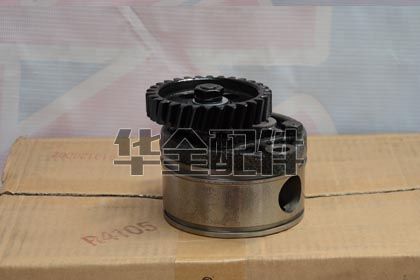
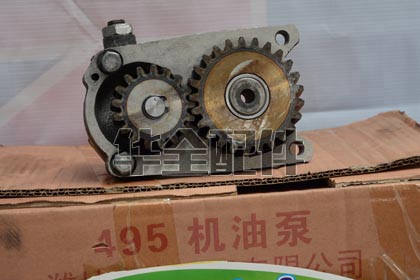
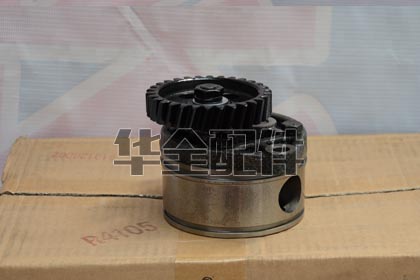
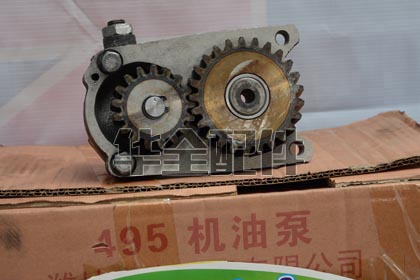
Three types: (1) External gear pump — two meshing gears (drive gear and idler gear) rotating in a close-clearance housing. Oil enters the expanding cavity on the inlet side and is carried between the gear teeth to the outlet side where the meshing teeth force it out. Simple, robust, and most common on medium/large diesel generators; (2) Gerotor (generated rotor) pump — an inner rotor with external teeth driving an outer rotor with internal teeth (one more tooth than the inner). The eccentric mounting creates expanding and contracting chambers. Compact, smooth flow (less pulsation), common on smaller engines; (3) Vane pump — spring-loaded sliding vanes in a rotor that create expanding/contracting chambers. Excellent flow at low RPM (good for variable-speed engines) but wears faster with contaminated oil. Generator engines primarily use gear-type pumps for their ruggedness. HUAQUAN supplies replacement oil pumps for all types.
Which engine brands are HUAQUAN oil pumps compatible with?
HUAQUAN oil pumps are manufactured for: Cummins (4BT-6CT, ISB-ISL, QSB-QSL, NT855, KTA19/38/50, QSK), Perkins (1103-4008), Deutz (912-2015), Weichai (WD615/618, WP10/12/13/17, 226B, 6160-6200), Yuchai (YC4-YCK), Shangchai (SC4H-SC33W), and all Chinese diesel platforms. Each oil pump is supplied fully assembled with: pump body, gears/rotors, drive gear, pressure relief valve (set to specification), and gasket/O-ring kit. Pumps are flow-tested on a calibration bench to verify output at rated speed meets or exceeds OEM specification.
How often should the oil pump be inspected or replaced?
Inspection: (1) Oil pressure monitoring — the best continuous inspection. A trending drop in oil pressure over months of operation (at the same oil temperature and RPM) indicates pump wear or bearing clearance increase; (2) Oil pan removal and pump inspection at every major overhaul (10,000-25,000 hours depending on the engine). Measure: gear-to-housing clearance (0.05-0.15mm), gear tooth tip-to-housing clearance (0.03-0.10mm), gear end clearance (0.02-0.08mm). If any measurement exceeds specification by 50%+, replace the pump; (3) Replace the pump at major overhaul if the engine has experienced a contaminated oil event (coolant in oil, fuel dilution, dust ingestion) — particles that have circulated through the pump have accelerated wear. Replacement at every second major overhaul (20,000-50,000 hours) is considered prudent for engines in critical service.
What causes oil pump cavitation?
Cavitation is the formation and violent collapse of vapor bubbles on the pump's suction (inlet) side, causing: (1) Reduced oil flow — vapor bubbles displace oil; (2) Erosion damage — collapsing bubbles impact the metal surface of the pump gears and housing with microscopic water-hammer forces, pitting the surface; (3) Noise — a characteristic growling or gravelly sound. Causes: (1) Restricted oil pickup screen — sludge, debris, or gasket material blocking the oil pump inlet screen; (2) Overfilled oil — the crankshaft whips the oil into foam (aerated oil), which the pump attempts to pump — air is compressible, destroying flow; (3) Cold thick oil at start-up — the oil is so viscous the pump cannot draw it through the pickup tube fast enough; (4) Wrong oil viscosity — oil that is too thick for the ambient temperature; (5) High oil temperature — reduced viscosity increases the pressure drop in the suction line, promoting cavitation. Prevention: maintain correct oil level, use the correct viscosity grade for ambient conditions, and clean the pickup screen at major service.
What is the function of the oil pressure relief valve?
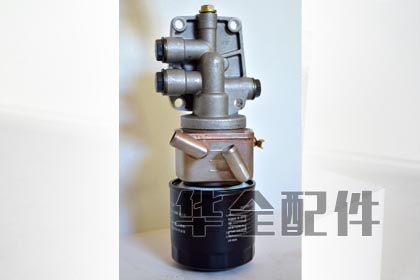
The relief valve (typically a spring-loaded ball or poppet valve, sometimes integral to the oil pump body or mounted in the oil filter head) limits maximum system oil pressure to protect the filter (burst pressure typically 10-15 bar), gaskets, and oil cooler. At cold start with thick oil, the pump could generate 10-15+ bar if unrestricted — the relief valve opens at its set pressure (typically 5-7 bar) and bypasses excess oil back to the oil pan or pump inlet, maintaining safe system pressure. A relief valve stuck open: low oil pressure at all engine speeds because oil is constantly bypassing. Stuck closed: pressure spikes at cold start (8-10+ bar) that can burst the filter canister. The relief valve should be inspected and cleaned during oil pump service — a varnished or corroded valve is a common cause of oil pressure problems.
What is the correct oil pressure for a diesel generator engine?
Oil pressure at operating temperature (oil at 80-100 degrees C): (1) Idle (600-800 RPM): minimum 1.0 bar (15 PSI), typical 1.5-3.0 bar; (2) Rated speed (1,500/1,800 RPM): minimum 3.0-3.5 bar (45-50 PSI), typical 4.0-6.0 bar. These are guidelines — follow the engine manufacturer's specification. Pressure below minimum at rated speed: shut down immediately and investigate. Pressure consistently lower than historical baseline for this particular engine (at the same oil temperature) — schedule inspection even if still above minimum. Rule of thumb: 10 PSI per 1,000 RPM is a safe minimum for journal bearing engines. Turbocharged engines may specify higher minimum pressure because the turbocharger's floating journal bearings require adequate oil flow for both lubrication and cooling.
How do I prime a new oil pump before engine start-up?
Priming is essential — a dry pump cannot draw oil from the pan because it relies on the oil to seal the internal clearances. Procedure: (1) Pack the pump gears/rotors with assembly lubricant (moly-graphite assembly lube or petroleum jelly) during installation — this provides the initial seal and lubricates the pump at first rotation; (2) Fill the oil filter with clean oil before installation; (3) After oil pan filling, disable the engine from starting (disconnect the fuel solenoid or ECU power), and crank the engine in 15-second bursts with 30-second rest periods; (4) Watch the oil pressure gauge — it should rise within 10-15 seconds of cranking; (5) If no pressure after 4-5 cranking attempts, stop: the pump has not primed. Refill the pump with assembly lube, pre-fill the oil galleries through the oil pressure sender port with a pressurized oil priming tank (the preferred method for large engines), and try again. Never start an engine with a new oil pump without confirming oil pressure during cranking.

总成-1.jpg)
总成.jpg)
总成-2.jpg)
总成-3.jpg)