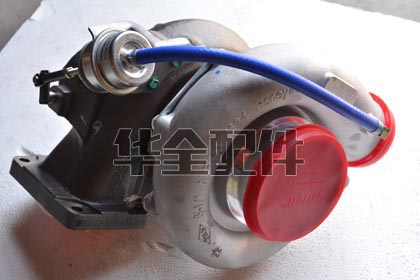
What is a generator turbocharger and how does it work?
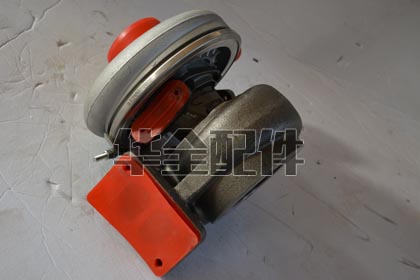
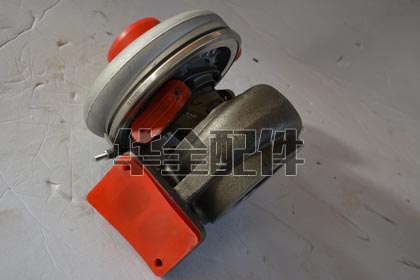
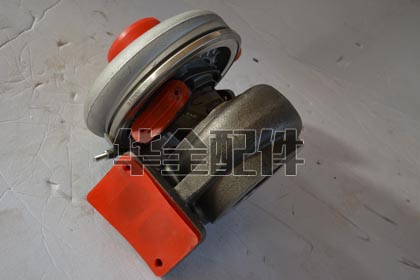
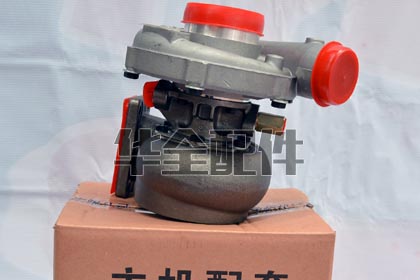
A turbocharger is an exhaust-driven forced induction device that compresses the intake air before it enters the engine cylinders, allowing more fuel to be burned per power stroke — thereby increasing power output from a given engine displacement by 50-200%+. Working principle: exhaust gas exiting the engine at high temperature (500-700 degrees C) and pressure enters the turbine housing, where it expands across the turbine wheel (a radial-inflow turbine spinning at 40,000-120,000+ RPM), extracting energy. The turbine wheel is connected by a common shaft to the compressor wheel on the opposite side — as the turbine spins, the compressor wheel draws in ambient air and compresses it to 0.5-3.0 bar above atmospheric (boost pressure) before forcing it into the intake manifold. The shaft connecting the two wheels runs in floating journal bearings (sliding sleeve bearings) that float on a film of pressurized engine oil — this oil also cools the shaft, which absorbs heat from the turbine side. A turbocharger is the highest-speed rotating component on any engine, and among the most thermally and mechanically stressed.
What are the signs of turbocharger failure?
Failure symptoms: (1) Blue/white exhaust smoke at all loads — oil leaking past the turbocharger shaft seals into the exhaust (blue = burning oil) or compressor side (entering intake); (2) Whining, screeching, or grinding noise — the compressor wheel contacting the housing (shaft play exceeded bearing clearance limit) or bearing failure; (3) Loss of power/loss of boost — the turbocharger is not producing rated boost pressure. The engine feels 'flat' and cannot achieve rated load; (4) Excessive oil consumption — oil is being consumed through the turbocharger seals faster than through the piston rings; (5) Oil in the intake piping (intercooler and hoses) — a significant oil pool indicates compressor-side seal leakage; (6) Shaft play — with the engine off and cold, remove the intake pipe and attempt to move the compressor wheel radially (side-to-side) and axially (in-out). Radial play exceeding 0.05-0.10mm or any axial contact between the wheel and the housing requires turbocharger replacement; (7) Visible turbine wheel or compressor wheel damage — bent, chipped, or eroded blades.
How long should a generator turbocharger last?
Turbocharger service life under normal generator operating conditions: 15,000-30,000 operating hours is typical for a well-maintained unit. Factors that shorten life: (1) Poor oil quality or extended oil change intervals — the turbocharger bearings depend on clean oil at the correct pressure (3-5 bar). Dirty oil or low-pressure accelerates bearing wear; (2) Hot shutdowns — shutting down the engine immediately after operating at full load. The turbine housing is at 500+ degrees C, and if oil flow stops while the shaft is still at 300+ degrees C, the residual oil in the bearings 'cokes' (solidifies into hard carbon), destroying the bearings on the next start-up; (3) Air filter neglect — a dirty or disintegrating air filter allows dust into the compressor. At 80,000 RPM, dust particles abrade the compressor blades at high velocity, creating an 'eroded' or 'sandblasted' appearance; (4) Exhaust gas temperature (EGT) exceeding the turbocharger's rated limit — sustained over-temperature weakens the turbine wheel material (typically Inconel 713C or Mar-M-247) and can cause creep (blade stretch). A turbocharger that 'lets go' at 80,000 RPM is a catastrophic event — the turbine wheel fragments can exit the exhaust, and compressor fragments can enter the engine.
Which engine brands are HUAQUAN turbochargers compatible with?
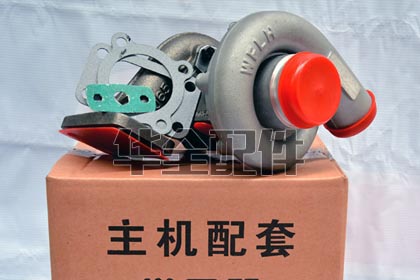
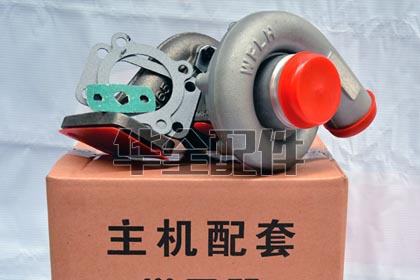
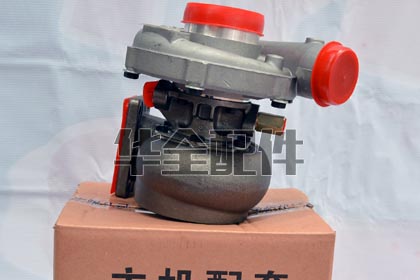
HUAQUAN turbochargers are manufactured for: Cummins (4BT, 6BT, 6CT, ISB, ISC, ISL, NT855, KTA19/38/50 — Holset HX/HY series compatible), Perkins (1103-4008), Deutz (912-2015 — KKK/Schwitzer series), Weichai (WD615/618, WP10/12/13/17, 226B, 6160-6200), Yuchai (YC4, YC6, YCK), Shangchai (SC4H-SC33W), and all Chinese diesel platforms. Types: wastegated turbochargers (integral wastegate actuator to limit boost at high engine speeds) and free-floating (non-wastegated, sized for constant-speed generator operation). HUAQUAN turbochargers are supplied with gasket kit, oil feed line, and oil drain flange gasket. They are pre-balanced to G2.5 (ISO 1940) and tested on a VSR (Vibration Sorting Rig) before shipment.
What is turbo lag and does it affect generator engines?
Turbo lag is the delay between the throttle being opened (increased fuel delivery) and the turbocharger producing full boost — it takes time for the exhaust energy to accelerate the turbine-compressor assembly from its current speed to the speed required for full boost. Turbo lag has minimal impact on constant-speed generator engines because: (1) Generators run at a fixed speed (1,500/1,800 RPM), so the turbocharger baseline speed is already elevated — typically 50-70% of maximum speed even at no load. The speed range to reach full boost is smaller than in a vehicle; (2) Generator load changes are gradual — a generator ramps up load over seconds, not milliseconds; (3) Modern electronic engine controls anticipate load increase and adjust fueling rate to match — the ECU will not request maximum fuel until boost is available. Turbocharger sizing for generator applications favors responsiveness over peak efficiency — a slightly smaller turbocharger is selected to ensure it 'lights off' at relatively low exhaust flow.
What is turbocharger cooldown and why is it critical?
Cooldown (idle-down) is running the engine at no load for 3-5 minutes after operating at significant load before shutting down. Critical because: (1) The turbine housing and wheel have been at 500-700 degrees C. If oil flow stops while the turbocharger is still hot, the oil in the bearing clearance (0.03-0.08mm) reaches temperatures of 300+ degrees C and 'cokes' — the lighter oil fractions evaporate, leaving hard carbon deposits that act like sandpaper on the next start; (2) The idling period allows: the turbine temperature to drop below the oil coking threshold (~200 degrees C), the oil circulating through the bearings to carry away heat, and the turbocharger shaft RPM to drop from 80,000+ to near-idle speed; (3) For generators without a cooldown timer in the controller: after manual shutdown, the operator must monitor EGT (if available) or simply idle 5 minutes before stopping. A turbo timer (aftermarket device that keeps the engine idling for a preset time after the key is turned off) is strongly recommended for manually operated generators.
How should I inspect a turbocharger during generator service?
Inspection procedure: (1) Remove the intake duct/hose from the compressor inlet — inspect the compressor wheel blades for: dust erosion (sanded appearance), foreign object damage (bent or chipped blades), and oil residue (leaking compressor seal); (2) Grasp the compressor wheel nut and attempt to move the shaft: radial (side-to-side) maximum 0.05-0.15mm (varies by turbo size — refer to the service manual), axial (in-out) maximum 0.05-0.10mm. Any contact between the wheel and the housing (scrape marks) requires immediate replacement; (3) Spin the shaft by hand — it should spin freely with no roughness, binding, or scraping sounds; (4) Inspect the turbine side (through the exhaust outlet if accessible) — look for blade erosion, cracking (heat fatigue), or oil coking on the turbine wheel back face; (5) Check the wastegate actuator (if equipped) — apply regulated compressed air to the actuator and verify the wastegate valve opens at the specified pressure (typically marked on the actuator bracket); (6) Inspect oil feed and drain lines for kinks, leaks, or carbon blockage — a restricted oil drain causes oil to back up and push past the seals.
What is a wastegate turbocharger and how does it differ from a free-floating turbo?
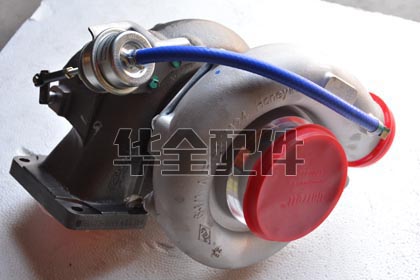
A wastegate turbocharger has a bypass valve (wastegate) in the turbine housing that, when opened, allows a portion of the exhaust gas to bypass the turbine wheel, limiting the turbocharger's maximum speed and boost pressure. A spring-loaded pneumatic actuator (connected to the compressor outlet/boost pressure) opens the wastegate when boost reaches a preset level. Purpose: allows the turbocharger to be sized small enough to provide good low-speed response (generator load acceptance) without over-boosting at rated speed. A free-floating turbocharger has no wastegate — the turbocharger is sized so that at the engine's rated speed and load, the turbine extracts exactly the right amount of energy to produce the required boost without exceeding limits. Free-floating turbos are simpler and more common on constant-speed generator engines where the operating point is narrow. HUAQUAN supplies both types — verify which your engine was originally equipped with.
What causes turbocharger overspeed?
Turbo overspeed (the shaft exceeds its rated maximum RPM — typically 100,000-150,000 RPM depending on the model) is caused by: (1) Compressor outlet leak (boost leak) — the turbocharger control system (wastegate or ECU) is regulating boost based on the manifold pressure. If there is a large leak between the turbocharger and the intake manifold, the manifold pressure drops, the control system commands more boost, and the turbocharger overspeeds trying to overcome the leak; (2) Wastegate actuator failure — the actuator diaphragm ruptures or the linkage seizes, the wastegate never opens, and boost continues to rise uncontrolled; (3) Overspeed from a load dump — if the generator is at full load and the main breaker trips, the engine instantly unloads but the turbocharger is still spinning at full speed, and the energy from the exhaust (which has momentum in the manifold) can momentarily overspeed the turbo — modern ECUs have anti-overspeed fuel limiting; (4) Operation at high altitude without turbocharger re-rating — thinner air means the turbocharger must spin faster to achieve the same boost pressure. Turbocharger overspeed is extremely destructive — turbine wheel burst at 100,000+ RPM sends shrapnel through the exhaust system, and compressor wheel burst sends fragments into the engine intake.