
What Is an Automatic Transfer Switch (ATS)?
An Automatic Transfer Switch (ATS) is a critical component in any backup power system. It automatically detects a utility power failure and seamlessly switches the electrical load from the primary power source (grid) to a secondary source (generator) within seconds. When utility power is restored, the ATS transfers the load back and shuts down the generator after a cool-down period.
For businesses, hospitals, data centers, and industrial facilities, an ATS is not optional—it is essential for ensuring uninterrupted operations and protecting sensitive equipment from power fluctuations.
How Does an Automatic Transfer Switch Work?
The ATS continuously monitors voltage, frequency, and phase balance of both the primary and backup power sources. The switching logic follows this sequence:
- Monitoring Phase: The controller checks utility power parameters against preset thresholds
- Failure Detection: When voltage drops below 70-80% or a phase loss occurs, a timer starts (typically 0.5 to 6 seconds adjustable)
- Generator Start Signal: The ATS sends a start command to the generator
- Stabilization Wait: The ATS waits for generator output to stabilize (usually 3-30 seconds)
- Load Transfer: The switching mechanism transfers the load to the generator
- Retransfer: When utility power is restored and stable (typically 5-30 minutes verification), the ATS transfers back and initiates generator cool-down
Types of Automatic Transfer Switches
| Type | Mechanism | Transfer Time | Best For | Cost Level |
|---|---|---|---|---|
| Open Transition (Break-Before-Make) | Disconnects from source A before connecting to source B | 50–250 ms | Residential, commercial, most industrial applications | $–$$ |
| Closed Transition (Make-Before-Break) | Momentarily parallels both sources before disconnecting | <100 ms | Hospitals, data centers, critical processes | $$–$$$ |
| Soft Loading Transition | Gradually transfers load to minimize transients | Programmable | Large industrial with motor loads | $$$ |
| Bypass-Isolation ATS | Allows maintenance without power interruption via bypass switch | Varies | Mission-critical facilities, 24/7 operations | $$$$ |
| Static Transfer Switch (STS) | Solid-state electronic switching, no mechanical parts | 4–20 ms | Data centers, semiconductor manufacturing | $$$$ |
Key Specifications When Selecting an ATS
| Parameter | Typical Range | Notes |
|---|---|---|
| Rated Current (Amps) | 30A – 4000A | Match to generator output rating; common sizes: 100A, 200A, 400A, 600A |
| Voltage Rating | 120/208V – 600V | Single-phase or three-phase; match to system voltage |
| Number of Poles | 2-pole, 3-pole, 4-pole | 4-pole switches neutral; required in separately derived systems |
| Withstand / Closing Rating (WCR) | 10kA – 200kA | Short-circuit current rating; must exceed available fault current |
| Enclosure Rating | NEMA 1, 3R, 4, 4X, 12 | NEMA 1 indoor; NEMA 3R outdoor; NEMA 4X corrosive environments |
| Transfer Time | 50ms – 30s | Faster for sensitive electronics; open transition is typical |
| Controller Type | Basic relay to microprocessor | Microprocessor provides programmable settings, event logging, remote monitoring |
Common ATS Ratings by Application
| Application | Recommended ATS Size | Voltage / Phase | Transition Type |
|---|---|---|---|
| Residential Home (Single Generator) | 100–200A | 240V / 1-Phase | Open Transition |
| Small Commercial Office | 200–400A | 208V / 3-Phase | Open Transition |
| Apartment Building | 400–800A | 480V / 3-Phase | Open or Closed Transition |
| Hospital / Healthcare Facility | 600–3000A | 480V / 3-Phase | Closed Transition with Bypass |
| Data Center | 800–4000A | 480V / 3-Phase | Static or Closed Transition |
| Industrial Manufacturing Plant | 1200–4000A | 480V or 600V / 3-Phase | Open or Soft Loading |
Installation Considerations
- Service Entrance vs. Non-Service Entrance: When installed as the service entrance, the ATS must include a service disconnect breaker. Non-service entrance ATS requires a separate upstream breaker.
- 3-Wire vs. 4-Wire Systems: In a 4-wire system with switched neutral, the ATS must switch the neutral along with phase conductors to prevent ground-fault nuisance tripping.
- Generator Compatibility: Ensure the ATS supports 2-wire start (dry contact) or communicates with the generator’s controller protocol.
- Cable Entry: Top and bottom cable entry options; verify conduit space before ordering.
- Load Shedding: Some advanced ATS controllers include load-shedding modules to manage non-critical loads when on generator power.
- Surge Protection: Consider integrating TVSS (Transient Voltage Surge Suppression) for sensitive electronic loads.
Maintenance Requirements
- Visual inspection of contacts for pitting, arcing, or overheating — every 6 months
- Verify transfer time and retransfer delay settings — annually
- Clean enclosure interior and check for moisture or corrosion — annually
- Test the full automatic transfer sequence under load — annually
- Inspect and tighten all electrical connections — annually
- Verify controller battery (if equipped) — every 2 years
Popular ATS Brands
- ASCO (Emerson): Industry leader, wide range from 30A to 4000A, known for reliability in healthcare applications
- Kohler: Integrated generator + ATS packages, strong residential and commercial lineup
- Generac: Smart switch technology with load shedding, popular in residential and light commercial
- Eaton: Comprehensive industrial range including bypass-isolation and closed transition models
- Cummins: PowerCommand series designed to pair seamlessly with Cummins generators
- Socomec: European leader, strong in telecommunications and data center applications
Frequently Asked Questions
1. Do I need an automatic transfer switch for my generator?
If you need backup power to activate automatically during an outage without human intervention, yes. For manual portable generators, a manual transfer switch or interlock kit may suffice.
2. Can I use one ATS with multiple generators?
Standard ATS units are designed for a single generator. For multiple generators, you need a paralleling switchgear system with integrated ATS functionality or a multi-source controller.
3. How long does an ATS take to transfer power?
An open transition ATS typically transfers in 50–250 milliseconds. Closed transition and static transfer switches can achieve sub-20ms transfers. The total time from outage to generator power also includes generator start-up time (typically 3–10 seconds).
4. What’s the difference between 3-pole and 4-pole ATS?
A 3-pole ATS switches the three phase conductors only and uses a solid neutral. A 4-pole ATS also switches the neutral conductor, which is required when the generator is configured as a separately derived system to comply with NEC grounding requirements.
5. Can I install an ATS outdoors?
Yes, if the ATS is rated for outdoor installation. Look for NEMA 3R (rain-tight) or NEMA 4 (water-tight) enclosures. Service-entrance rated units are commonly installed outdoors at the utility meter location.
6. How often should an ATS be tested?
NFPA 110 requires monthly testing of emergency power supply systems (EPSS) including the ATS. A full load test is recommended at least annually. Many ATS controllers have built-in exercise timers to automate this.
7. What causes ATS failure?
Common causes include contact wear and pitting from frequent operation, control board failure due to power surges, mechanical linkage binding from lack of lubrication, and rodent damage to internal wiring. Regular inspection catches most issues before failure.
8. Can I upgrade from manual to automatic transfer switch?
Yes, you can retrofit an automatic transfer switch to replace a manual switch. The generator must have a 2-wire start capability (most standby generators do). You’ll also need to run a control cable between the ATS and generator.
Related Articles
- Digital Generator Control Panels — Complete Guide
- Generator Spare Parts FAQ
- Complete Generator Maintenance Guide
- Generator Parts Buying Guide
- OEM vs Aftermarket Generator Parts
- Generator Troubleshooting Guide
- Batteries and Chargers for Generators
- Generator Controller Parts Overview
Product Gallery
Cummins
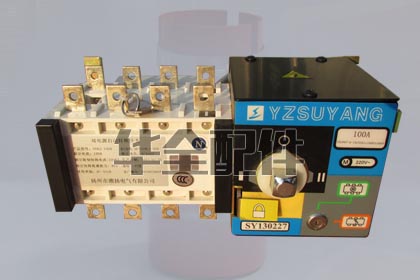
Various
FAQ
Q: What is an Automatic Transfer Switch (ATS) and how does it work?
A: An Automatic Transfer Switch (ATS) is an intelligent electrical device that automatically transfers load from the utility grid to a backup generator when power fails, and back when utility power is restored. It continuously monitors voltage and frequency on both sources via microprocessor-controlled sensors. When it detects a utility outage (voltage drops below 80-85% of nominal), the ATS sends a start signal to the generator, waits for the engine to reach rated speed and stable voltage (typically 5-15 seconds), then transfers the load through a motorized contactor mechanism. Transfer back occurs after a user-adjustable ‘return timer’ ensures utility stability — preventing nuisance cycling during intermittent outages.
Q: What are the main types of Automatic Transfer Switches?
A: There are four main ATS types: (1) Open Transition (Break-Before-Make) — the most common type, creates a momentary power interruption of 50-500ms during transfer, suitable for most commercial and industrial applications; (2) Closed Transition (Make-Before-Break) — momentarily parallels both sources to achieve seamless no-break transfer, required for data centers and hospitals but needs utility approval; (3) Soft Load (Passive Synchronization) — gradually ramps load transfer to minimize voltage/frequency transients on sensitive equipment; (4) Bypass-Isolation — allows the ATS mechanism to be isolated for maintenance without interrupting power, critical for hospitals and 24/7 facilities. Within these categories, switching mechanisms include contactor-based (100A-1200A), molded case (30A-1000A), and power frame circuit breaker type (800A-5000A).
Q: What ATS amperage rating do I need for my generator setup?
A: ATS amperage rating must match or exceed your service entrance rating or generator output breaker rating — whichever is higher. For a 100kW/125kVA generator at 480V three-phase, the rated current is 150A — select a 200A or 225A ATS to allow 25-50% future capacity headroom. Common residential applications: 100A-200A for whole-house standby generators (20-48kW). Commercial/light industrial: 400A-800A for 150-500kW generators. Industrial/prime power: 1200A-4000A for 800kW-3MW gensets. Always verify the ATS withstand and close-on ratings (WCR) exceed available fault current at the installation point — this is commonly overlooked and can cause catastrophic failure during short-circuit events.
Q: Which ATS brands are compatible with HUAQUAN generators?
A: HUAQUAN supplies ATS units compatible with all major generator controllers including Deep Sea Electronics (DSE 4520, 4620, 7320, 8610), ComAp (InteliLite, InteliGen, InteliMains), Woodward/EGCP, Deif (AGC-4, AGC 200), Smartgen (HGM6100, HGM7200), Lovato (RGK series), and Datakom (DKG series). Our ATS units directly interface with ASCO, Cummins PowerCommand, Kohler, Generac, Eaton, Socomec, and ABB transfer switch mechanisms. Cross-brand compatibility is achieved through industry-standard 2-wire start, CAN bus J1939, Modbus RS-485, and dry contact interfaces. Contact us with your generator controller model for guaranteed compatibility verification.
Q: How long does an ATS take to transfer power during an outage?
A: Standard open transition ATS completes transfer in 50-500 milliseconds (3-5 cycles). The total outage duration includes: utility failure detection (200ms-2s), engine start delay (0-10s adjustable), generator warm-up/stabilization (5-15s for diesel, 3-10s for gas), and the actual transfer time (50-500ms). Total typical outage: 10-30 seconds for diesel generators. For critical applications requiring zero interruption, closed transition ATS can achieve seamless transfer under 100ms by momentarily paralleling both sources, though this requires the utility and generator to be within 5% voltage, 0.2Hz frequency, and 5-degree phase angle of each other — verified by synchroscope or automatic synchronizer.
Q: What is the difference between 3-pole and 4-pole ATS?
A: A 3-pole ATS switches the three phases (A, B, C) but has a solid neutral connection — the generator and utility neutrals are permanently bonded. A 4-pole ATS switches all four conductors including the neutral. The choice depends on grounding system configuration: Use 3-pole when your system has a single service entrance with the neutral-to-ground bond at the main switchboard only (most common in North America); use 4-pole when multiple neutral-to-ground bonds exist (separately derived systems), when GFCI/ground fault protection is required on both sources, or when the generator is a separately derived system per NEC 250.30. Incorrect pole selection can create dangerous neutral current paths and nuisance GFCI tripping.
Q: How do I test and maintain an Automatic Transfer Switch?
A: ATS maintenance schedule: (1) Monthly visual inspection — check for overheating, discoloration, loose connections, and rodent intrusion; (2) Quarterly operational test — simulate a utility outage by opening the utility breaker or using the ATS test switch, verify complete transfer sequence including generator start, load transfer, cool-down, and retransfer; (3) Semi-annually — torque all power connections (loose connections account for 40% of ATS failures), clean contactor tips with a non-residue solvent, measure contact resistance (should be below 50 micro-ohms for new contacts); (4) Annually — full infrared thermographic scan under load, verify all timing settings against site requirements, test the manual transfer mechanism. Keep a detailed maintenance log for warranty compliance and NFPA 110 documentation.
Q: Why does my ATS keep transferring back and forth (nuisance cycling)?
A: Nuisance cycling is typically caused by: (1) Return-to-utility timer set too short — increase to 5-15 minutes minimum; (2) Unstable utility voltage near the dropout threshold — check if voltage sags from nearby motor loads (elevators, large HVAC) are triggering false outages; (3) Sensor sensitivity too high — adjust voltage dropout to 80% and pickup to 90% of nominal; (4) Loose sensing wire connections causing intermittent voltage readings; (5) Generator instability — frequency or voltage hunting during warmup triggering the ATS to abort transfer. Also check for phase rotation errors after utility maintenance — some ATS models will reject a source with reversed phase rotation.
Q: Can I install an ATS outdoors?
A: Yes, but only with a NEMA 3R (rainproof), NEMA 4 (watertight), or NEMA 4X (corrosion-resistant stainless steel) rated enclosure. Standard NEMA 1 indoor enclosures will fail rapidly outdoors due to moisture, insects, and UV degradation. For outdoor installations: ensure proper clearance for door swing and ventilation, install a rain hood or shelter in areas with heavy snowfall, use enclosure heaters in humid climates to prevent internal condensation, and protect control wiring with liquid-tight flexible conduit. In coastal or corrosive environments, specify NEMA 4X stainless steel with conformally coated control boards to prevent salt-spray damage.
Q: What is the difference between an ATS and an MTS (Manual Transfer Switch)?
A: An ATS automatically detects power loss and transfers loads without human intervention — essential for unattended backup operation. An MTS requires an operator to physically throw a switch to transfer between utility and generator. ATS advantages: immediate response (under 30 seconds), no on-site personnel needed, protects against outages during unattended hours. MTS advantages: lower cost (60-70% less than equivalent ATS), simpler mechanism with fewer failure points, no parasitic control power consumption. MTS is suitable for portable generator hookups, construction sites, and applications where an operator is always present. For critical infrastructure, commercial buildings, and unattended sites, ATS is the standard and often required by code (NFPA 110 for emergency systems, NFPA 99 for healthcare).
Q: What size generator do I need to work with a 200A ATS?
A: A 200A ATS at 240V single-phase handles approximately 48kW (200A x 240V = 48,000W). For three-phase 480V, the same switch handles about 166kW. The generator must be sized to match your actual load, not the ATS rating — the ATS is simply the pass-through device. For a 200A residential service, typical generator sizing is 20-48kW based on managed load selection. For a 200A 480V commercial service, 100-150kW. The critical selection parameter is inrush current: large motors (elevators, chillers, fire pumps) can draw 6-8x running current during start — the generator must have sufficient kVA and motor-starting capability (typically 200-300% of rated kW for 10 seconds) to start the largest motor while carrying base load.
Q: How does an ATS communicate with the generator controller?
A: ATS-to-generator communication uses multiple interfaces: (1) Two-wire start — the most basic, universal method; the ATS closes a relay contact to initiate generator start and opens it for stop. Requires a dedicated twisted-pair control cable; (2) CAN bus (J1939) — digital communication allowing the ATS to read generator status (voltage, frequency, oil pressure, coolant temp, fault codes) and send precise commands; (3) Modbus RS-485 — widely used in industrial installations for multi-generator paralleling systems; (4) Ethernet/Modbus TCP — for remote monitoring over building management systems. Control wiring must be run in separate conduit from power cables, minimum 18 AWG shielded twisted-pair for distances up to 500m. For runs over 500m, use a fiber optic link with RS-485 to fiber converters.
Q: What safety certifications should a generator ATS have?
A: Essential ATS certifications: IEC 60947-6-1 (international standard for transfer switching equipment), UL 1008 (mandatory for North America — certifies the ATS has passed 6,000+ endurance operations, short-circuit withstand, and temperature rise tests), CSA C22.2 No. 178 (Canada), and CE marking (Europe). For emergency/standby applications, verify the ATS is listed for ‘Emergency’ or ‘Optional Standby’ use per the UL 1008 application category. Additional certifications to look for: IEEE C37.20.1 (metal-enclosed switchgear), IEC 61439 (low-voltage assemblies), and seismic qualification (IBC/CBC) for installations in seismic zones. HUAQUAN ATS products carry IEC 60947-6-1 and CE certifications with UL 1008 available for North American orders.
Q: How do I troubleshoot an ATS that won’t transfer to generator?
A: Systematic troubleshooting: (1) Verify the generator starts when the ATS signals — check the 2-wire start circuit for continuity and correct polarity; (2) Confirm the generator reaches rated voltage and frequency — the ATS will not transfer if voltage is outside 85-110% or frequency outside 95-105% of nominal; (3) Check the ATS control board for fault/status LEDs — common faults include phase rotation error, under-voltage lockout, or transfer time delay not expired; (4) Manually operate the transfer mechanism using the manual handle — if it moves freely but won’t transfer electrically, suspect the motor operator or solenoid; (5) Verify sensing voltage at the ATS generator-side terminals — a missing phase or blown control fuse will prevent transfer even if the generator is running. Always isolate power before opening the ATS enclosure for troubleshooting.
Q: What is the typical lifespan of an Automatic Transfer Switch?
A: A properly maintained ATS typically lasts 25-35 years. The contactor mechanism is rated for 6,000-10,000 operations at full load per UL 1008 / IEC 60947-6-1 — this equates to 30+ years at normal outage frequency (3-4 transfers/month). The control electronics have a shorter expected life of 15-20 years due to capacitor aging and component drift; replacement control boards are available for all major ATS brands. Key factors reducing lifespan: frequent transfers (over 100/year), operation in high-dust/high-humidity environments without proper enclosure protection, lack of periodic maintenance, and repeated short-circuit events that degrade contact surfaces. HUAQUAN provides replacement parts and control boards for legacy ATS models from the past 20 years.
Q: Can I use a single ATS with multiple generators?
A: Yes — this requires an ATS with integrated generator paralleling control or an external generator bus management system (GBMS). For simple dual-generator redundancy: a dual-generator ATS can alternate or duty-cycle between two generators, starting the second if the first fails. For complex multi-generator systems (3+ units): an external master controller (ComAp InteliSys, Deep Sea 8610 MKII, Woodward EasyGen) coordinates multiple ATS units and generators through load-dependent start/stop to optimize fuel efficiency. The ATS must be equipped with CAN bus communication to interface with the generator management system. Contact HUAQUAN for system design support for multi-generator installations.